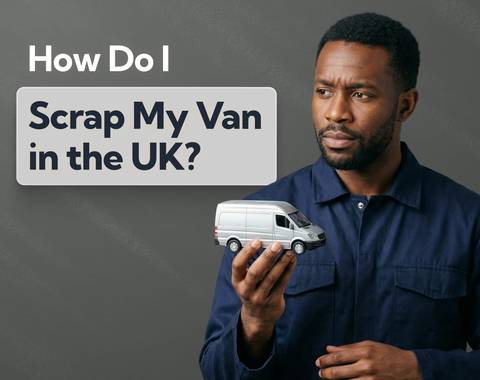
How Do I Scrap My Van in the UK?
Scrapping a van is pretty much the same process as scrapping a car. But vans are heavier, often business-owned and sometimes modified, which means there are a few extra things worth knowing before you hand it over. Here's the full process, in plain English.
Last updated: 20th April, 2026

Award-winning CEO driving growth and social impact across automotive, recycling, and technology-led enterprise platforms.
Listen to this story
Scrapping a van means handing it to a licensed Authorised Treatment Facility (ATF), which is the only type of business that’s legally permitted to dispose of end-of-life vehicles in the UK.
The process is straightforward: you get a quote, arrange a free collection, hand over your V5C logbook and finally receive a Certificate of Destruction (CoD), which ends your legal responsibility for the van. Payment comes by bank transfer (not cash, importantly).
Whether your van is a non-runner, failed its last MOT or just not worth repairing, it still has scrap value. Get an instant valuation with your reg and find out what yours is worth today.
What's in this article
- 3. What happens to my van after it is scrapped?
- 4. What is a Certificate of Destruction and why do I need it?
- 5. How do I notify the DVLA after scrapping my van?
- 6. What should I watch out for when scrapping my van?
- 7. Can I scrap a commercial or fleet van?
- 8. How do I get the best price when I scrap my van?
How much can I get to scrap my van?
A small van typically fetches somewhere between £200 and £300, while a large commercial van like a long-wheelbase Transit or Sprinter will normally bring in £400 to £600 or more. Those ranges move with the metal market (and there are a few other factors at play), so the figure you're quoted today might differ from what one of your mates got six months ago.
Below is a breakdown of everything that goes into the scrap value of a van so you know what to expect.
What factors affect my van's scrap price?
There are five main factors that affect your van's scrap price:
- Size and weight of the van: Scrap metal is priced by weight. More metal equals a higher payout, which is why a large panel van will always return more than a compact city van, even when both are in identical condition. Your van's kerb weight, which you'll find in the manual or logbook, gives you a good ballpark estimate of its scrap metal value.
- Current scrap metal market rates: Scrap dealers base most of their pricing on the value of metals like steel, aluminium and copper. Since vans are made mostly of steel, the going rate per tonne plays the biggest role in what you'll be offered. Scrap metal prices change month to month depending on global demand and recycling markets, so it’s worth keeping an eye on if you're not in a rush (though the swings don’t normally justify waiting months to sell).
- Condition and completeness of the van: A van that still starts and drives is normally worth more than one that doesn't. And scrap dealers pay more for vans that are complete because they can remove working engines, gearboxes and mechanical parts and sell them on before disposing of the rest. A stripped shell will only fetch scrap metal rates and may be harder to collect. So, leave your van as-is and you'll get a better price.
- Location and collection accessibility: Where you're based affects how much your van is worth, simply due to transport costs and competition between scrap dealers. In cities and towns, dealers are more competitive and prices tend to be higher. In rural areas, fewer dealers mean less competition, and travel time for collection may reduce your payout.
- Make, model and parts demand: Popular makes like Ford Transit and Mercedes Sprinter vans go for more simply because their parts are in higher demand. Newer vans also carry more resale potential, as their components are often still usable in the second-hand market. A less common model won't necessarily get you less in scrap metal terms; it’s just that it probably won’t attract the same parts premium.
How much do different types of vans get for scrap?
The type of van you're scrapping makes a big difference to what you'll be offered because, again, different vans have different weights and parts demand.
Here's a rough breakdown by category, keeping in mind that actual quotes move with the metal market and your van's condition:
- Small vans (Ford Transit Connect, VW Caddy): These sit in the 1,400-1,600 kg range, which puts most scrap quotes between £200 and £300. The metal volume isn't huge, but both the Transit Connect and Caddy have solid parts demand in the UK. So if your van is still complete, that can work in your favour.
- Medium vans (Ford Transit Custom, Vauxhall Vivaro): These ones are heavier and therefore more valuable. Most weigh somewhere between 1,800 and 2,100 kg and typically fetch £300 to £500. They’re the workhorses of the UK van market; parts demand is consistent, and dealers know exactly what they can pull from them.
- Large vans and panel vans (Ford Transit LWB, Mercedes Sprinter, VW Crafter): Long-wheelbase and high-roof models come in at 2,500+ kg and above, so quotes in the £400 to £600+ range are realistic. Sprinters and Crafters with intact engines and catalytic converters are worth getting multiple quotes on parts since demand for these models is strong enough that some dealers will pay well above pure metal rates.
- Campervans and converted vans. This is the one category where it's worth pausing before going straight to scrap. The conversion itself (beds, insulation, solar panels, kitchen units) carries no scrap value. The van gets priced on its base weight as if none of it exists, so if the conversion is decent quality and the vehicle is reasonably recent, selling privately or through a specialist buyer will almost certainly beat scrap. And if you do need to scrap one, it's more involved than a regular van. The gas systems, water lines, electrical installations and furniture inside them require more intricate depollution and dismantling than a typical panel van. Not every ATF will do it.
How do I scrap my van step by step?
The process of scrapping your van is remarkably straightforward when you do it online. Just get a quote, book a collection and hand over the paperwork. Using a licensed ATF isn't optional, it's a legal requirement, but going through Car.co.uk means every dealer you're comparing is already registered.
Here's how it works from start to finish:
How do I get a free valuation for my van?
Getting a quote takes a couple of minutes and costs nothing. There are four steps to do so:
- Enter your van's registration number: This is the number on your number plate, but you can also find it in your V5C logbook. Your reg pulls up the make, model, age and engine details automatically, so there’s no need to dig for that info.
- Provide van condition and location details: You'll be asked a few quick questions about the van's condition (e.g. whether it starts and drives, whether it's complete and where it's located). These details help the system calculate the van’s overall value. Overstating its condition won't help; the collector will assess it on arrival anyway.
- Compare quotes from licensed scrap dealers: The system connects you with ATF-registered car scrap yards, so every quote you see comes from a licensed operator. Compare them, factor in collection availability if timing matters to you and pick the one that works best.
Accept and book a collection slot: Once you've found a quote you’re happy with, you schedule a collection time that works for you. Most dealers offer same-day and next-day collection, and it's free regardless of where you're based or whether the van is a non-runner.
What documents do I need to scrap my van?
Three things to have ready before collection day:
- V5C logbook: The ATF needs your V5C logbook to process the scrappage and notify the DVLA. It also serves as your main proof of legal responsibility for the van. It’s not always required (there are alternatives) but it is highly preferred because it makes the process go smoother.
- Valid photo ID: By law, licensed dealers have to record the identity of anyone selling a vehicle for scrap. A driving licence or passport satisfies this requirement. If this is an individual sale, you’ll also have to provide proof of address.
- Service history (if available). This isn’t a legal requirement, but is definitely worth having if you've got it. A full service history confirms the van has been maintained and that key components are genuine, which can support a stronger quote if the dealer is factoring in parts value on top of scrap metal weight.
Can I scrap my van without a V5C logbook?
It’s possible to scrap your van without the V5C logbook, but it takes more legwork on your end. Without a V5C, the ATF can't complete the standard DVLA notification process, so the responsibility shifts to you as the registered keeper to inform the DVLA directly that the vehicle has been scrapped. You cannot use the GOV.UK service for this; you must do it by post.
You'll also need to provide something else that links you to the vehicle, such as an insurance policy document. Most ATFs will still accept the van under these conditions, but it's worth confirming before you book a collection, as individual facilities vary.
If you've genuinely lost your V5C, the cleaner option is to apply for a replacement through the DVLA using a V62 form before scrapping. It costs £25 and arrives within five working days. That way the paperwork is clean and you don’t have to physically post a scrappage notification letter to the DVLA’s main office.

What happens on the day of collection?
Once your collection slot is booked, this is what to expect:
- Handing over proof of ownership: When the driver arrives, they’ll take the V5C and fill in the relevant section (V5C/3) to confirm the van is being scrapped. You’ll keep the yellow slip for your own records, as it’s your proof the vehicle left your hands legally. Have your photo ID and proof of address ready too.
- Van is collected by a licensed operator: The driver loads the van and takes it to the ATF for depollution and dismantling. You don't need the van to be roadworthy either; if it's a non-runner, the right equipment comes with the collection vehicle. The quote you accepted covers collection, so there's nothing extra to pay on the day.
- Payment by bank transfer: Once the van is collected and the details are confirmed, payment is sent directly to your bank account. Cash isn't an option (it's illegal under the Scrap Metal Dealers Act 2013), so if the yard offers that, they aren’t operating legitimately.
- Certificate of Destruction issued: The ATF is legally required to issue a Certificate of Destruction within seven days of scrapping your van. This formally ends your legal responsibility for the vehicle. Keep it, because if a query ever comes back to you about the van's history or disposal, it's your proof that everything was handled correctly.
What happens to my van after it is scrapped?
Once the driver collects your van, it goes to an Authorised Treatment Facility where it's depolluted, dismantled and processed for recycling.
It's a more involved process than most people expect – that is, the van isn't just crushed and done. Hazardous materials are removed first, usable parts are recovered for the second-hand market, and what's left is shredded and sorted by metal type.
The ATF also handles the DVLA paperwork and issues your Certificate of Destruction, which is what formally ends your legal responsibility for the vehicle.
What is an Authorised Treatment Facility?
An Authorised Treatment Facility (ATF) is a licensed vehicle recycling centre regulated by the Environment Agency in England, or its equivalent bodies in Scotland, Wales and Northern Ireland. ATFs are the only businesses in the UK legally allowed to scrap end-of-life vehicles.
Unlicensed dealers can't notify the DVLA (you need a licence number for that), so they aren’t able to issue a Certificate of Destruction. That means you’re still legally on the hook for the van, which exposes you to potential legal issues if it somehow makes it back on the road.
How does an ATF process a scrap van?
An ATF processes a scrap van through four main steps: depollution, component removal, parts recovery and metal recycling.
- Fluids drained and safely disposed: Engine oil, brake fluid, coolant, fuel and air conditioning refrigerant are all removed first. These are hazardous materials and can't just be tipped — ATFs handle disposal under strict environmental regulations to prevent soil and water contamination.
- Batteries, tyres and airbags removed: Batteries – including the high-voltage packs in electric vans – are extracted and sent to dedicated recycling facilities. Tyres can't be shredded with the rest of the vehicle and can't be stockpiled due to fire risk, so they go to specialist recyclers. Airbags contain small explosive charges and have to be safely deactivated before the vehicle is dismantled further. All three require specialist handling.
- Usable parts recovered for resale: Before the shell goes to the crusher, the dealer removes salvageable components. Engines, gearboxes, catalytic converters, alternators and body panels from high-demand models can all find their way into the second-hand parts market (which is part of why complete vans are worth more than stripped ones).
- Metal shell crushed and sent for recycling: What's left after depollution and parts recovery gets shredded and sorted by metal type. Steel, aluminium and copper are separated and sent to mills and foundries to be melted down and reused. The UK's End-of-Life Vehicle regulations require that at least 95% of a vehicle's materials are recovered or recycled, and ATFs are set up specifically to meet that standard.
What is a Certificate of Destruction and why do I need it?
The Certificate of Destruction (CoD) is the document the ATF issues once your van has been totally scrapped. It confirms the vehicle has been permanently taken off the road, updates the DVLA's records and, most importantly, ends your legal responsibility for it as the registered keeper.
Without it, you're still legally liable for it because the DVLA has no formal way of knowing it’s left your possession. If the van were somehow misused, abandoned or linked to an incident after, the DVLA's records would still point to you.
The ATF is required by law to issue the CoD within seven days of scrapping the vehicle. Once you have it, keep it indefinitely and verify online that the vehicle’s been deregistered. It’s your permanent proof that the disposal was handled correctly and legally.
How do I notify the DVLA after scrapping my van?
The ATF will usually notify the DVLA on your behalf as part of the scrapping process, but the legal responsibility sits with you as the registered keeper, regardless. If the notification doesn't go through for any reason, you're the one who's liable, so it's worth confirming it's been done rather than just assuming.
Failure to notify could lead to a fine of up to £1,000, and you'll remain responsible for any tax, fines and incidents that are linked to the vehicle until the DVLA updates its records.
How do I tell the DVLA my van has been scrapped?
The steps to tell the DVLA you’ve scrapped your van are as follows:
- Complete the V5C logbook: Before handing the V5C to the ATF, fill in the yellow V5C/3 section labelled ‘sell, transfer or part-exchange your vehicle to the motor trade’, then give the rest to the ATF or collection team. That's your proof the vehicle legally left your hands on a specific date, and it’ll include the details of the scrap yard the vehicle was taken to.
- Notify the DVLA online via GOV.UK: You can notify the DVLA via their online service, which updates their records immediately and generates a confirmation. This is the quickest and most reliable method, and it's worth doing even if the ATF has said they'll handle it. It takes a couple of minutes and removes any doubt.
- Confirm the Certificate of Destruction has been issued: Again, the ATF legally has to issue this within seven days of scrapping your van. Once you have it, check that the vehicle’s registration number, make and model are correct. If something’s wrong, contact the ATF immediately. Keep the CoD permanently alongside your DVLA confirmation.
Do I need to cancel road tax and SORN my van before scrapping it?
You don't need to cancel your road tax before scrapping your van, but you might need to declare it as a SORN.
When the DVLA gets notified that your van has been scrapped, they automatically cancel your road tax and refund the full unused months. You don't need to apply for this separately, and you’ll get a cheque for it in the post within six weeks.
SORN is only relevant in specific situations. If your van is taxed/MOT’d and being collected promptly, you don't need to declare it at all. The two scenarios where it does apply:
- You're keeping the van without valid tax. Every vehicle needs to be taxed as long as it’s on public land, or else you can be fined. The SORN is the formal way of saying you’re storing it privately.
- You're storing it on private land while breaking it for parts. Again, SORN is required while the vehicle is off the road, awaiting or during dismantling.
One other reason to consider it proactively: if there's a gap between now and collection and you want to reclaim an extra month of road tax, declaring SORN early, with the van moved onto private land, triggers the refund automatically.
What the experts say

Steven Jackson OBE

What should I watch out for when scrapping my van?
Most of the van scrappage process is rather straightforward when you're using a legitimate operator, but ‘legitimate operator’ is the keyword. There are plenty of scrap vehicle scams out there you have to protect yourself from.
Watch out for the following things, and you’ll be safe:
- Never accept cash: It's been illegal to pay cash for scrap vehicles in the UK since the Scrap Metal Dealers Act 2013. Any dealer offering cash is operating outside the law, and accepting it puts you at risk too. Payment should always come by bank transfer.
- Verify the ATF is licensed: Not every business that calls itself a scrap dealer is actually registered. To verify a licensed scrap yard, you can check the Environment Agency's public register (or the equivalent in Wales, Scotland or NI) to confirm a facility holds a valid environmental permit. Otherwise, your van won’t be scrapped properly and you won’t get the CoD.
- Avoid dealers who skip identity checks: A licensed ATF is legally required to verify your identity before completing the transaction. If a dealer shows no interest in who you are or asks for no documentation whatsoever, that's a red flag. Legitimate operators follow the Scrap Metal Dealers Act — those checks are part of the process.
- Watch for last-minute price deductions: A common tactic among shady scrap buyers is to agree a price online or over the phone and then drop the offer on collection day, citing fees that were never advertised on the quote. Assuming you were honest up front about the vehicle’s condition, a reputable dealer will always pay exactly what they quote you for.
- Always get a Certificate of Destruction: If it hasn't arrived within seven days of your van being scrapped, contact the ATF directly and ask for confirmation it's been raised on the DVLA's system. A legitimate operator will be able to provide that immediately. If they're unresponsive or can't confirm it, contact the DVLA directly to check whether the vehicle has been marked as scrapped on their records. If it hasn't and the dealer has gone quiet, report it to the Environment Agency.
Can I scrap a commercial or fleet van?
Yes, businesses can scrap fleet vans through exactly the same legal process as a private individual. Licensed ATF, V5C handover, DVLA notification, Certificate of Destruction, the whole lot. What differs when scrapping a fleet vehicle is the authorisation and paperwork side of things.
Three considerations when it comes to this:
- Scrapping a van registered to a business: Most fleet vans are registered to the business rather than an individual. The main difference with fleet disposal is that the person arranging the scrappage needs to be authorised to act on the company's behalf.
- What documents does a business need to scrap a van? The core documents are the same as for a private individual: the V5C logbook, a valid photo ID for the person handling the transaction and their proof of address along with it. But in addition to that, most ATFs will also require a formal letter signed on company letterhead.
- Arranging bulk or fleet van collections: Car.co.uk can arrange fleet disposal nationwide. Rather than handling each vehicle as a separate job, it’s possible to coordinate fleet collections across multiple sites and scheduled around your operational timeline. Each van still goes through the full legal process (and you’re still paid on the spot), but the logistics are managed as a single operation.
How do I get the best price when I scrap my van?
Aside from its scrap metal weight (which is the same regardless), getting the best price for your scrap van ultimately comes down to how complete it is parts-wise, how it’s presented and what the yard is willing to offer, which will depend on market rates and local competition.
Here are a few tips you can follow to maximise scrap value:
- Get multiple quotes. Scrap prices aren't fixed, and different dealers sometimes offer slightly higher or lower amounts based on their location, current stock and how much they want your van's parts. An online scrap van service like Car.co.uk pulls quotes from multiple local ATFs in one go, so you're comparing numerous offers at once instead of settling for the first number you see.
- Keep the van complete. Dealers price vans based on their full metal weight plus parts value. If you strip the catalytic converter, wheels or engine, you'll see the quote drop accordingly. Leave it as-is and let the ATF recover what they can unless you’re highly confident you can resell those parts privately at a high price.
- Be accurate about the van’s condition. It's tempting to oversell this when you’re getting a quote, but the dealer will assess it on collection day regardless. If there's a huge discrepancy between what you claimed and what’s in front of them, they’ll revise the offer on the spot. Give an honest description up front, and the quoted price is what you can expect to be paid.
- Time it if you can. Scrap metal prices move with global commodity markets and tend to be stronger in spring and summer. If you're not in a rush and rates are currently low, waiting a few weeks might nudge the figure up. It's not worth holding out for months, but it's worth being aware of where the market is before you commit.
- Check your road tax refund. It's not part of the scrap quote, but it's money you're owed. Any full months of remaining road tax get refunded automatically once the DVLA is notified. If you declared SORN before collection, that refund triggers earlier (worth factoring in if you're trying to maximise the overall return).
Get an instant quote simply by entering your reg, and see what your van is worth today.
About Car.co.uk

Share on
Latest news & blogs