Car Theft Statistics in the UK
This guide covers the latest UK car theft statistics, including annual totals, the most stolen cars and brands, regional hotspots, how and when vehicles are taken, what happens to them after and what you can do to protect yours.
Last updated: 20th April, 2026

Award-winning CEO driving growth and social impact across automotive, recycling, and technology-led enterprise platforms.

Listen to this story
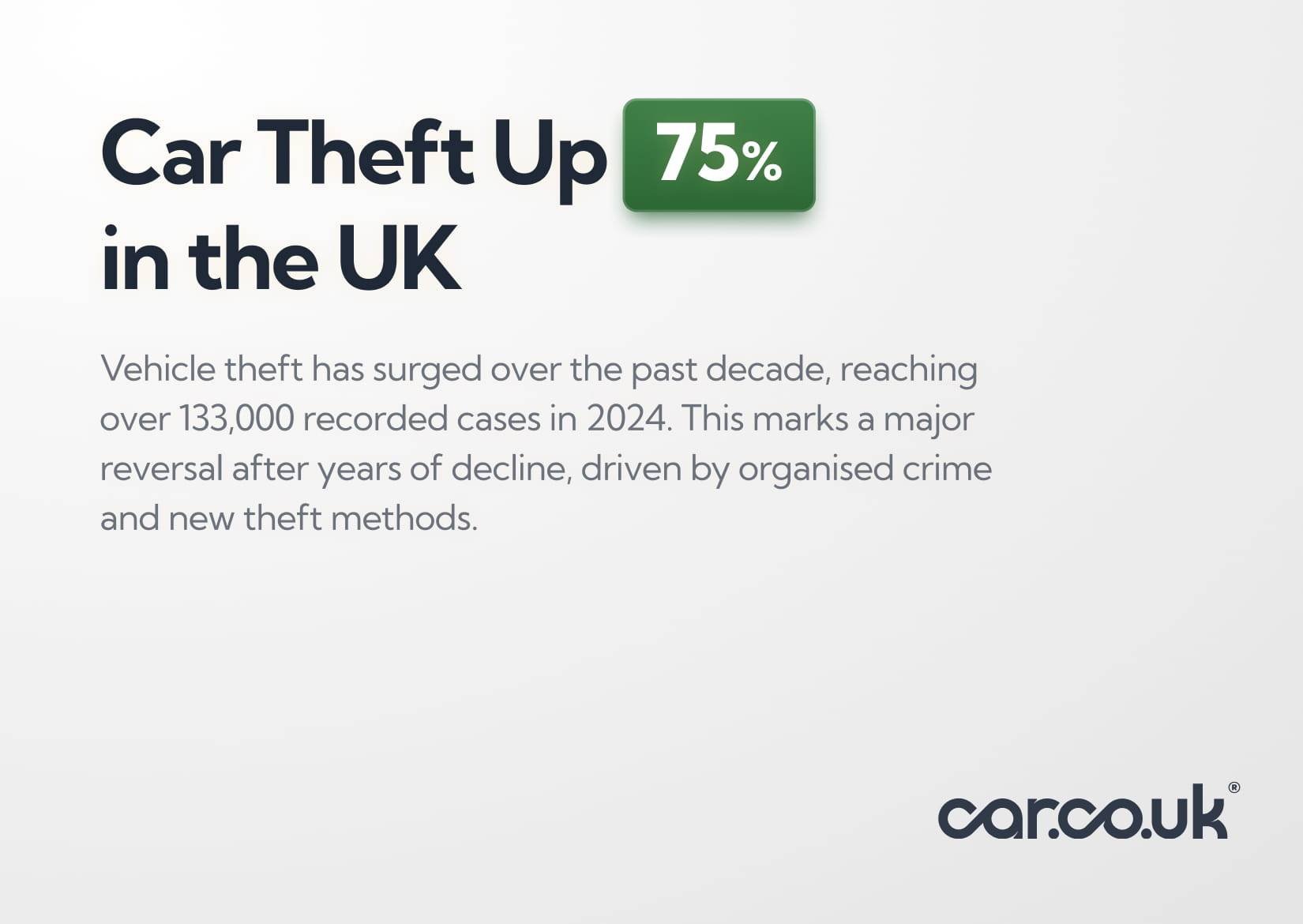
Car theft in the UK has surged 75% since 2013-14, reaching over 133,000 police-recorded thefts in 2024. And the problem is getting worse, not better. According to the RUSI June 2025 report, the total economic and social cost now stands at at least £1.77 billion a year.
Now… understanding these figures requires you to know how they're measured. Police recorded crime – published by the Home Office – captures thefts reported to police, while the ONS Crime Survey for England and Wales (CSEW) estimates total victimisation including unreported incidents. Both paint the same picture: vehicle theft is a serious, growing threat.
Knowing where, when and how cars are stolen is the first step toward not becoming a statistic yourself.
What's in this article
- 1. UK Car Theft Statistics Overview
- 2. How many cars are stolen in the UK each year?
- 3. How many vehicles are stolen every day in the UK?
- 4. Which cars are stolen the most in the UK?
- 5. Are keyless entry cars at a higher risk of theft?
- 6. What are the most common electric vehicles targeted for theft in the UK?
- 7. Where are cars most commonly stolen in the UK?
- 7.1 Which UK cities and regions have the highest car theft rates?
- 7.2 Are cars more likely to be stolen at home or in public car parks?
- 7.3 Which streets and locations are the most common car theft hotspots?
- 7.4 Is car theft more prevalent in urban areas than rural areas?
- 7.5 Which UK postcodes have the highest number of vehicle thefts?
- 7.6 Which parking locations carry the greatest risk of car theft in the UK?
- 8. When are cars most commonly stolen in the UK?
- 8.1 Which month of the year sees the highest number of car thefts?
- 8.2 What time of day are cars most frequently stolen?
- 8.3 Are car thefts more common on weekdays or weekends?
- 8.4 Does car theft increase during the Christmas and holiday period?
- 8.5 Has car theft increased or decreased over the last 10 years?
- 9. What are the most commonly stolen car parts in the UK?
- 9.1 Which car parts are targeted most frequently by thieves in the UK?
- 9.2 Why are catalytic converters a commonly stolen car part in the UK?
- 9.3 How much is a stolen catalytic converter worth on the black market?
- 9.4 Which car models are most at risk of catalytic converter theft?
- 9.5 Are alloy wheels and tyres a common target for car part thieves?
- 10. What happens to stolen cars in the UK?
- 10.1 What percentage of stolen cars are ever recovered in the UK?
- 10.2 How long does it typically take for a stolen car to be recovered?
- 10.3 Where do stolen cars end up after they are taken?
- 10.4 How often are stolen cars used in other criminal activities?
- 10.5 Are stolen cars more likely to be stripped for parts or resold?
- 11. Organised vehicle crime in the UK
- 12. How are cars stolen? Methods of entry
- 13. The cost and impact of car theft in the UK
- 14. How car theft affects your insurance
- 15. UK car theft vs international comparison
- 16. What are the most effective ways to prevent car theft in the UK?
- 16.1 What security devices are most effective at preventing car theft?
- 16.2 Which steering wheel locks and physical deterrents work best against thieves?
- 16.3 How effective are GPS trackers at recovering stolen vehicles?
- 16.4 What are the best ways to protect a keyless entry car from relay theft?
- 16.5 How much can the right security measures reduce the risk of car theft?
- 17. Government and police response to car theft
- 18. Future predictions for car theft in the UK
UK Car Theft Statistics Overview
Car theft continues to rise sharply across the UK, with increasing volumes, higher financial impact, and low recovery rates making it a growing concern for drivers. The figures below provide a clear snapshot of theft trends, frequency, regional risk, and the wider economic impact, helping you understand how serious the issue has become and where the biggest risks lie.
How many cars are stolen in the UK each year?
The UK recorded over 133,000 car thefts in 2024, or roughly one for every 287 vehicles on the road, according to GoCompare's FOI analysis. In England and Wales alone, the Home Office recorded 129,127 thefts in 2023-24, itself 8% higher than the 123,000 recorded in 2019.
The longer trend is stark. Vehicle thefts have risen 75% since 2013-14, with only a brief interruption during the COVID-19 lockdowns of 2020-21. That dip proved short-lived, as thefts rebounded sharply in 2021-22 and have remained higher since.
2025 update: DVLA figures show 52,299 vehicles stolen in the first seven months of 2025. That’s 247 per day, up 48.5% on 2024's daily average. At that rate, annual thefts could exceed 90,000 by year end.
Outside England and Wales, Scotland recorded ~5,090 vehicle thefts in 2023-24 (stable since 2015). And Northern Ireland recorded 995, which is down more than 50% from 2,066 in 2011-12.
Car thefts across the United Kingdom
How many vehicles are stolen every day in the UK?
Based on 133,000 thefts recorded in 2024, approximately 364 vehicles were stolen every day in the UK. A separate DVLA estimate puts the theft frequency at once every eight minutes.
In 2025, that figure shifted a bit: DVLA data analysed by Tempcover puts the 2025 daily average at 247, though that reflects only the first seven months of the year and may not capture seasonal peaks.
UK car theft year-by-year trend (2013-2025)
Annual totals give you a snapshot, but the year-by-year trend is what tells the real story. What you’ll notice when you zoom out is a near-unbroken climb from a historic low in 2013-14, interrupted only briefly by COVID-19 lockdowns, before rebounding to levels not seen in over a decade.
The 75% rise since 2013-14 obscures just how sudden the surge was. Thefts were virtually flat between 2013-14 and 2014-15, then accelerated sharply from mid-2015 onwards as relay and CAN bus theft technology proliferated.
The COVID-19 dip in 2020-21 was dramatic, but thefts rebounded by over 20% in each of the following two years. The marginal dip in 2023-24 offers little comfort given where the baseline now sits.
Which cars are stolen the most in the UK?
Car theft in the UK isn’t totally random. The vehicles criminals target most consistently fall into two broad categories: high-volume everyday models that are easy to steal due to keyless entry vulnerabilities, and premium SUVs and saloons that command serious resale or export value.
Motorcycles and mopeds are also a major target, particularly in London. In the city, criminals often steal them to use in other crimes before abandoning them or stripping them for parts.
DVLA national data and Met Police FOI data both point to the same underlying logic — desirability, ease of theft, parts demand and export potential all factor into which vehicles end up on a thief's shopping list.
The sections below break this down by brand, model, segment and vehicle age, drawing on both national DVLA figures and London-specific Met Police data covering over 39,000 individual vehicle thefts.
What are the most stolen car brands in the UK?
At a national level, Ford is the most stolen car brand in the UK by a huge margin. DVLA data analysed by Zego puts Ford at 8,233 thefts in 2024, more than 50% ahead of second-placed BMW.
In London, the picture shifts slightly. Honda tops the Met Police FOI dataset largely due to high volumes of motorcycle and moped theft in the city. For cars only, Ford and Mercedes-Benz lead the capital too.
Most stolen car brands in London (2024)
Which car model has the highest theft rate in the UK?
The Ford Fiesta is the most stolen car in the UK, with 4,446 reported stolen in 2024. That’s nearly 2.6 times more than the second-placed Volkswagen Golf. The top 20 most stolen models combined for 22,489 thefts in 2024, with the Fiesta alone accounting for nearly one in five of those.
There are two reasons for this:
- The sheer number of Fiestas still on UK roads
- Strong demand for parts following Ford's decision to discontinue the model in 2023
Here’s a full breakdown:
Most commonly stolen car models in the UK (2024)
Theft rate per registered vehicle tells a slightly different story. Lexus owners face odds of roughly 1 in 39 of having their car stolen due to how aggressively keyless-entry luxury vehicles are targeted. Abarth sits at the other end at 1 in 116, but that gap narrows quickly once you factor in how few Abarths are on the road to begin with.
Are keyless entry cars at a higher risk of theft?
Keyless entry cars are at a higher risk of theft, and the gap is widening. They’re primarily vulnerable to two attack methods:
- Relay theft: Criminals use a signal amplifier to capture the key fob's signal from inside the owner's home and relay it to a device held next to the car, tricking it into unlocking and starting without the physical key present.
- CAN bus injection: Thieves physically access the vehicle's ECU through an exposed entry point (typically the headlight housing) using plug-in devices disguised as harmless electronics (e.g. JBL speakers).
The scale of investment involved points firmly to organised crime rather than opportunism:
- Bespoke theft devices for higher-end vehicles have sold for over £20,000, according to RUSI's June 2025 report.
- Cheap knockoffs from China are now appearing, as a way of lowering the barrier to entry.
- Online tutorials have partially democratised techniques once limited to well-resourced criminal networks.
The ONS CSEW data reflects how fast this has moved. Signal manipulation from a remote locking device accounted for 14.6% of all vehicle entry methods in 2023-24. That figure was effectively zero before 2018. Manufacturers are investing heavily in countermeasures, but RUSI characterises the situation as an ‘arms race’ that criminals have so far kept pace with.
Which car colours are most targeted by thieves?
Black and grey top the list, with 5,434 and 4,450 thefts respectively in 2024 according to DVLA data analysed by MoneySuperMarket. White and silver also feature heavily.
It's less about thieves preferring these colours and more about the fact that these are simply the most common colours on UK roads — grey alone has been the UK's best-selling new car colour for seven years running. Brighter colours get stolen less often because they're harder to move on quickly without being noticed.
Are older or newer cars more vulnerable to theft?
The short answer is both older or newer cars are vulnerable to theft, but for different reasons.
Vehicles aged between five and ten years old are the most commonly stolen, accounting for around 39% of reported thefts in 2022-23. That sweet spot reflects a combination of factors:
- Old enough to have weaker or outdated security
- Common enough that parts are in demand
- Still valuable enough to be worth targeting
And older cars, particularly those made before 2000, normally don’t have electronic immobilisers, which made them possible to steal without any specialist equipment.
Newer cars present a different problem. Immobilisers and alarms are standard, but keyless entry systems introduce relay and CAN bus vulnerabilities that criminals have become highly adept at exploiting.
The result is a vulnerability curve that dips in the middle but stays elevated at both ends, with the 5-10 year bracket sitting squarely in the highest-risk zone.
Which car segments are stolen the most in the UK?
Nationally, DVLA data is published by make and model rather than body type, so the most granular segment breakdown available comes from Met Police FOI data covering 39,494 vehicle thefts in London between January 2023 and January 2024.
While London skews the picture (i.e. for motorcycles and mopeds), the broad pattern is likely representative of national trends.
Most stolen car segments in London (2023-24)
The dominance of saloons and estates reflects the volume of Ford, Mercedes and BMW models in those body styles. The motorcycle and scooter figures are heavily London-specific, as moped crime is disproportionately a capital issue compared with the rest of the UK.
How does a car’s age affect its likelihood of being stolen in the UK?
The older your car, the less likely it is to be stolen, up to a point.
Vehicles aged five to ten years old carry the highest theft risk, accounting for around 39% of all reported thefts. These cars are old enough that security tech is probably outdated, but new enough that their parts are still in demand.
Risk drops off on both ends: newer cars benefit from stronger factory security, while very old cars are less targeted simply because demand for their parts has largely dried up.
DVLA model-level data backs this up consistently: 86% of stolen Fiestas were the 2008-2017 generation, over 90% of stolen Nissan Jukes were pre-2019, and more than 40% of stolen BMW 3 Series were the 2012-2019 model.


What are the most common electric vehicles targeted for theft in the UK?
EVs are actually less likely to be stolen than petrol or diesel cars. 2023 HPI research covering over 864,000 electric vehicles across the UK found that just 0.1% were stolen last year versus 0.2% of all vehicles. But the gap is narrowing as adoption grows and criminals adapt.
The risk profile isn’t statistically the same across all EV models, though. Kia and Hyundai models dominate the most-stolen EV list – with the E-Niro, Ioniq 5, EV6 and Kia Niro EV at the top – largely due to keyless entry vulnerabilities and strong secondhand demand.
Tesla, despite being the UK's best-selling EV brand, barely registers. Its embedded telematics and over-the-air security updates appear to be working quite effectively.
Most commonly stolen EVs in the UK (2023)
The broader trend to watch is hybrids. In 2025, Carwow reported that the Toyota C-HR hybrid topped the entire UK theft chart for the first time and is up 28% from 2024. This tells us criminals are shifting focus toward high-value electrified vehicles rather than just chasing volume.
Where are cars most commonly stolen in the UK?
Car theft is heavily concentrated in urban areas, especially London and the West Midlands. But there are a few rural areas that are seeing faster growth in theft rates than anywhere else. Below, you’ll see how the regional picture breaks down.
Which UK cities and regions have the highest car theft rates?
London is in a league of its own, with 105,211 vehicle thefts in the year ending September 2024, and 28.1% of all thefts in England and Wales.
Outside the capital, the West Midlands is the hardest-hit region, recording 5,413 stolen vehicles seized in 2024. That’s 22% of all seizures nationally, at a rate of 1 theft per 110 cars, or 1,451 per 100,000 residents.
Are cars more likely to be stolen at home or in public car parks?
Based on Table 2a from the ONS CSEW dataset, cars are overwhelmingly more likely to be stolen at home. Semi-private areas (driveways/garages) and streets near home combined account for around 73% of all vehicle thefts in 2024-25, versus just 6.2% from other car parks and 2.7% from work car parks. In other words, public car parks don't come close.
Which streets and locations are the most common car theft hotspots?
According to a postcode-level analysis from the RAC, East London is the worst-affected area in the entire UK, with Barking recording the highest rate of any postal area nationally: 648 thefts per 100,000 vehicles. Hayes and Thornton Heath are also among the most extreme hotspots.
By city, London leads by a wide margin with over 8,145 thefts, followed by Birmingham (3,220), Manchester (912), Leeds (901), Sheffield (899) and Coventry (862).
Is car theft more prevalent in urban areas than rural areas?
Car theft is significantly more prevalent in urban areas. Cities offer criminals two things rural areas don't: volume of targets and anonymity. The West Midlands alone recorded more vehicle thefts in 2024 than the whole of Scotland. At the other end, Norfolk and Suffolk recorded just 43 and 68 thefts per 100,000 residents respectively, both among the lowest rates in the UK.
Which UK postcodes have the highest number of vehicle thefts?
Per the RAC/This is Money postcode analysis, the highest-risk postal areas are concentrated in East London. Barking, Dagenham and Hayes top the list when measured by thefts per 100,000 registered vehicles. Thornton Heath in south London is also a high-risk area.
All of these areas combine dense on-street parking, high vehicle turnover and proximity to major road networks, making them attractive to organised theft groups.
Which parking locations carry the greatest risk of car theft in the UK?
Driveways and semi-private areas at or near home are the highest-risk parking location, making up 37% of all vehicle thefts in 2024-25. This shows just how much relay theft targeting keyless cars at home has grown over the years. Streets near home account for a further 36%. Public and work car parks combined make up around 18%.
Most common parking locations for vehicle theft (UK, 2025)
When are cars most commonly stolen in the UK?
Cars are most commonly stolen in the evening and night. Around 80% of all vehicle-related thefts occur between 6pm and 6am, with the dead of night (midnight to 6am) accounting for the largest single share. Weekdays see more theft than weekends, and darker months create more opportunity.
The sections below break down the timing data in full, drawn from ONS CSEW Tables 1a-1d.
Which month of the year sees the highest number of car thefts?
Met Police FOI data covering January 2023 to January 2024 shows September as the peak month for vehicle theft in London, with 3,259 thefts recorded that month. November was close behind at 3,185. April recorded the fewest at 2,858.
The pattern broadly tracks daylight hours. September and November combine still-high vehicle activity with rapidly shortening evenings, creating more opportunity for night-time theft. ONS CSEW data confirms the link, finding that around 78% of all vehicle-related thefts nationally occur in darkness.
Note: National month-by-month figures are not published by ONS CSEW, which reports annual aggregates only. The Met Police FOI dataset is the most granular monthly breakdown publicly available.
What time of day are cars most frequently stolen?
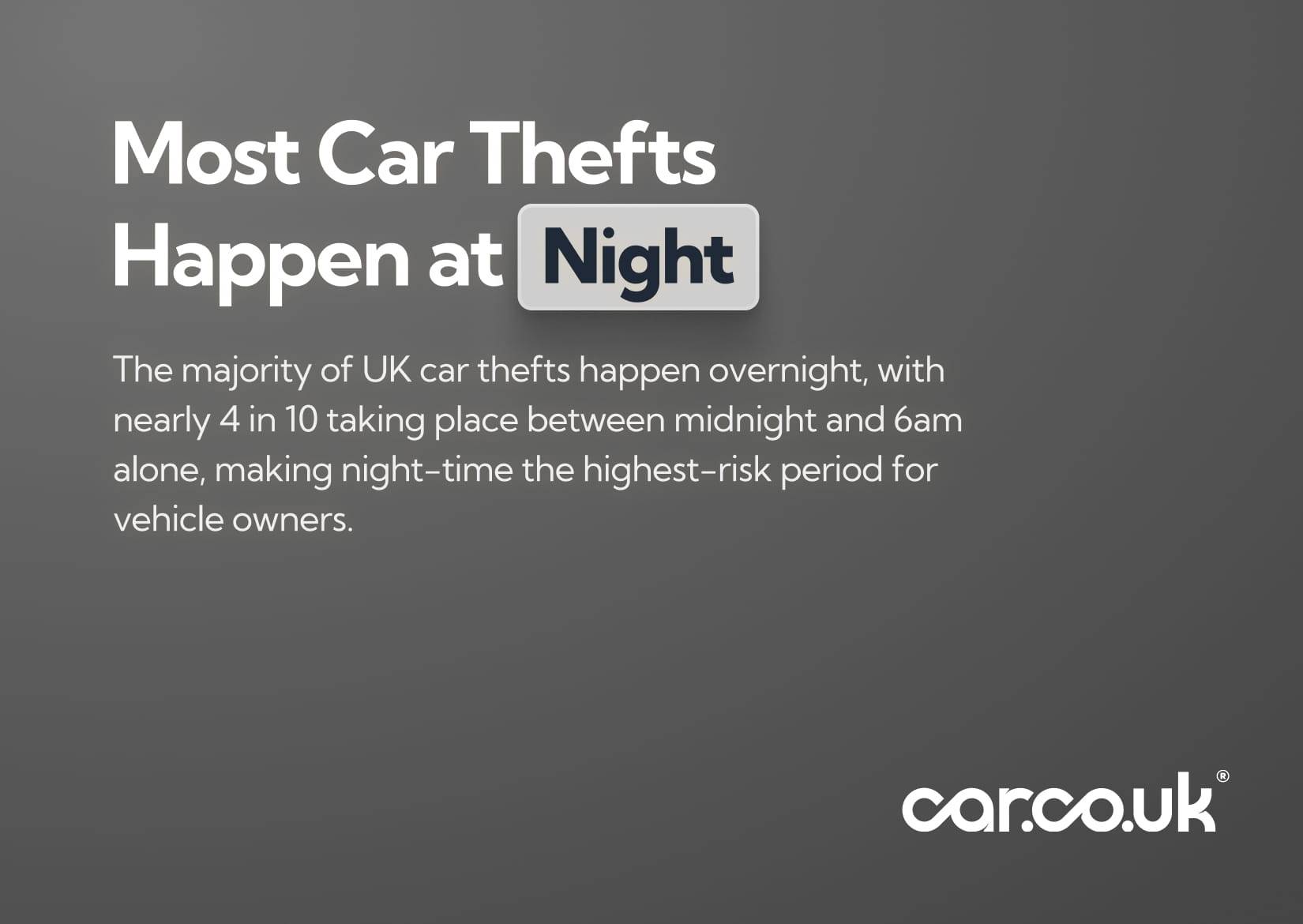
Night is by far the highest-risk period. In 2024-25, the Office for National Statistics reported that 75.3% of all vehicle thefts took place during the evening or night (6pm to 6am), with the night hours alone (midnight to 6am) accounting for 38.8% of all incidents. Evening thefts, which are split between early evening (14.8%) and late evening (16.7%), make up most of the remainder.
Daytime, on the contrary, is significantly safer. Morning and afternoon combined account for just 24.7% of thefts, with mornings (9.4%) slightly riskier than afternoons (11.7%). In terms of light conditions, 71.7% of thefts occur in darkness versus 27.8% in daylight.
According to ONS CSEW Table 1b, the proportions are as follows:
- Night (midnight to 6am): 38.8%
- Late evening (10pm to midnight): 16.7%
- Early evening (6pm–10pm): 14.8%
- Afternoon: 11.7%
- Morning: 9.4%
Are car thefts more common on weekdays or weekends?
Car thefts are more common on weekdays. In 2024-25, 61.8% of vehicle thefts happened during the week, compared with 38.2% at the weekend. That said, there’s a fairly notable shift from 2023-24, when the weekday share was higher at 68.1%, that suggests weekend theft is becoming more common.
Does car theft increase during the Christmas and holiday period?
There's no published national data that isolates Christmas as a distinct theft spike because the CSEW doesn't break figures down to that level of granularity. What we do know is that the conditions that drive theft are at their peak during winter: longer dark periods, more unattended vehicles and more valuables left in cars during the shopping season.
London’s Met Police FOI data shows November 2023 as one of the highest months for theft in London (3,185), consistent with the onset of winter darkness. December enforcement also ramps up significantly; police conducted 49,243 breath tests in December 2023, 138% above the monthly average. So, there’s more activity on the roads generally during this period.
Has car theft increased or decreased over the last 10 years?
Car theft in the UK has increased significantly over the last 10 years. Vehicle thefts have risen 75% since 2013-14, reversing two decades of consecutive annual decreases that had brought theft to a historic low.
The only interruption was a brief COVID-19 dip in 2020-21. But then thefts rebounded in 2021-22 and haven’t gone down since, with 2024's total of 133,000+ sitting 8% above 2019 levels despite a 6% fall from 2023's peak.
And the recovery rate tells an equally stark story. In 2024-25, just 25.6% of stolen vehicles were returned to their owners, down from 34% in 2014-15 and the lowest figure in the entire dataset. A decade ago, roughly one in three stolen cars made it back. Now it's fewer than one in four.
That combination – more theft and lower recovery – means the actual harm to vehicle owners has compounded considerably beyond what the theft figures alone suggest.
What are the most commonly stolen car parts in the UK?
Car part theft operates on a different logic to whole-vehicle theft. Stripped parts are harder to trace, faster to sell and require far less infrastructure to move than a stolen car. The result is a thriving black market for everything from number plates to catalytic converters and, increasingly, the contents of the vehicle itself.
The sections below break down what's being taken, from the most targeted components to the items thieves find when they break in.
Which car parts are targeted most frequently by thieves in the UK?
Number plates are the most commonly stolen car parts in the UK. 5,683 number plate thefts were reported to the DVLA in 2024 (up 68% since 2021) though the true figure is far higher, as most incidents are reported to police rather than the DVLA. Police-reported data put the figure at over 53,000 in 2021 alone.
The main reason number plates are such a common target is that they can disguise vehicles used in criminal activity and avoid being captured by ANPR cameras.
Beyond number plates, the most commonly stolen parts are:
- Catalytic converters: Large concentrations of platinum group metals
- Alloy wheels: High resale value, removable without specialist tools
- Wing mirrors: Particularly on premium models
- Car batteries: Especially high-voltage units from hybrids and EVs
- Airbags: Expensive to replace, straightforward to remove
- Vehicle badges and emblems: Low effort, consistent demand
Then you’ve got break-ins, which tell a different story to parts theft. Valuables (e.g. cash, cards, jewellery) are now the most commonly taken items from vehicles, accounting for 42.9% of all thefts from vehicles in 2024-25. Tools have nearly doubled in share to 10.7%, reflecting the growth in van break-ins targeting tradespeople. And electrical equipment has fallen sharply from 18.7% to 4.9%, mostly because modern sat-navs are no longer detachable.
Why are catalytic converters a commonly stolen car part in the UK?
Catalytic converters contain three precious metals: platinum, palladium and rhodium. All of these are worth more per ounce than gold. Their value on the legal market can be as high as £2,500+, depending on the type and its precious metal content.
On top of that, it’s possible for thieves to remove the converter in under two minutes with a battery-powered angle grinder. So for such a high potential reward, it’s something that can be done during a driver’s 10-minute trip to the bank or supermarket.
Hybrid vehicles are the primary target because their converters are used less frequently and run at lower temperatures, which means the metals inside are less corroded and therefore more have a higher precious metal content.
How much is a stolen catalytic converter worth on the black market?
A stolen catalytic converter typically fetches £100 to £600 on the black market for a standard converter, and up to £800+ for hybrids like the Toyota Prius.
A converter’s value is driven almost entirely by its platinum, palladium and rhodium content, with rhodium – which trades anywhere between £3,000 and £15,000 per troy ounce depending on market conditions – the key variable.
Street-level thieves normally receive just a fraction of the true metal value, with middlemen taking the bulk. But even at discounted rates plus middlemen’s fees, a crime that takes under two minutes to commit is well worth it for them.
Which car models are most at risk of catalytic converter theft?
According to GoCompare’s 2023 Freedom of Information analysis of police data across England and Wales, Toyota and Lexus models are most likely to have their catalytic converters stolen, with hybrids particularly targeted due to their higher precious metal content.
The Toyota Auris carries the highest catalytic converter theft rate of any model; one in every 157 Aurises had its catalytic converter stolen in 2023. The Lexus CT and Toyota Prius follow closely behind.
Most common cars for catalytic converter theft (UK, 2024)
By brand, Lexus is the highest-risk manufacturer overall at 1 in 326, followed by Honda (1 in 407) and Toyota (1 in 985). And seven of the top ten most targeted models had at least one hybrid variant.
What the experts say

Steven Jackson OBE

Are alloy wheels and tyres a common target for car part thieves?
Alloy wheels and tyres are common targets for car part thieves because they have excellent resale value and are relatively easy and quick to remove. In fact, alloy wheels rank as the second most commonly stolen car part in the UK according with between 15 and 20 sets stolen every week in major UK cities.
Reported wheel and tyre thefts rose around 25% between 2023 and 2024, with Hertfordshire the worst-affected area nationally and Durham recording the highest rate per capita at 41 cases per 100,000 people.
The interesting counterpoint is catalytic converters. Exclusive Auto Express data shows catalytic converter thefts have fallen by an average of 98% over the past three years, which makes for a dramatic reversal driven by falling precious metal prices and tighter scrap dealer regulations. As cat theft has declined, wheel theft appears to be filling the gap.
Locking wheel nuts remain the most effective deterrent. They’re inexpensive, widely available and enough of a time barrier to push opportunist thieves elsewhere.
What happens to stolen cars in the UK?
The reality is that once someone steals a car, the chances of getting it back are slim and getting slimmer. Thieves export vehicles overseas, strip them for parts, resell them with cloned identities or used in further criminal activity. The RUSI June 2025 report provides the most comprehensive picture of what organised vehicle crime actually looks like end-to-end.
What percentage of stolen cars are ever recovered in the UK?
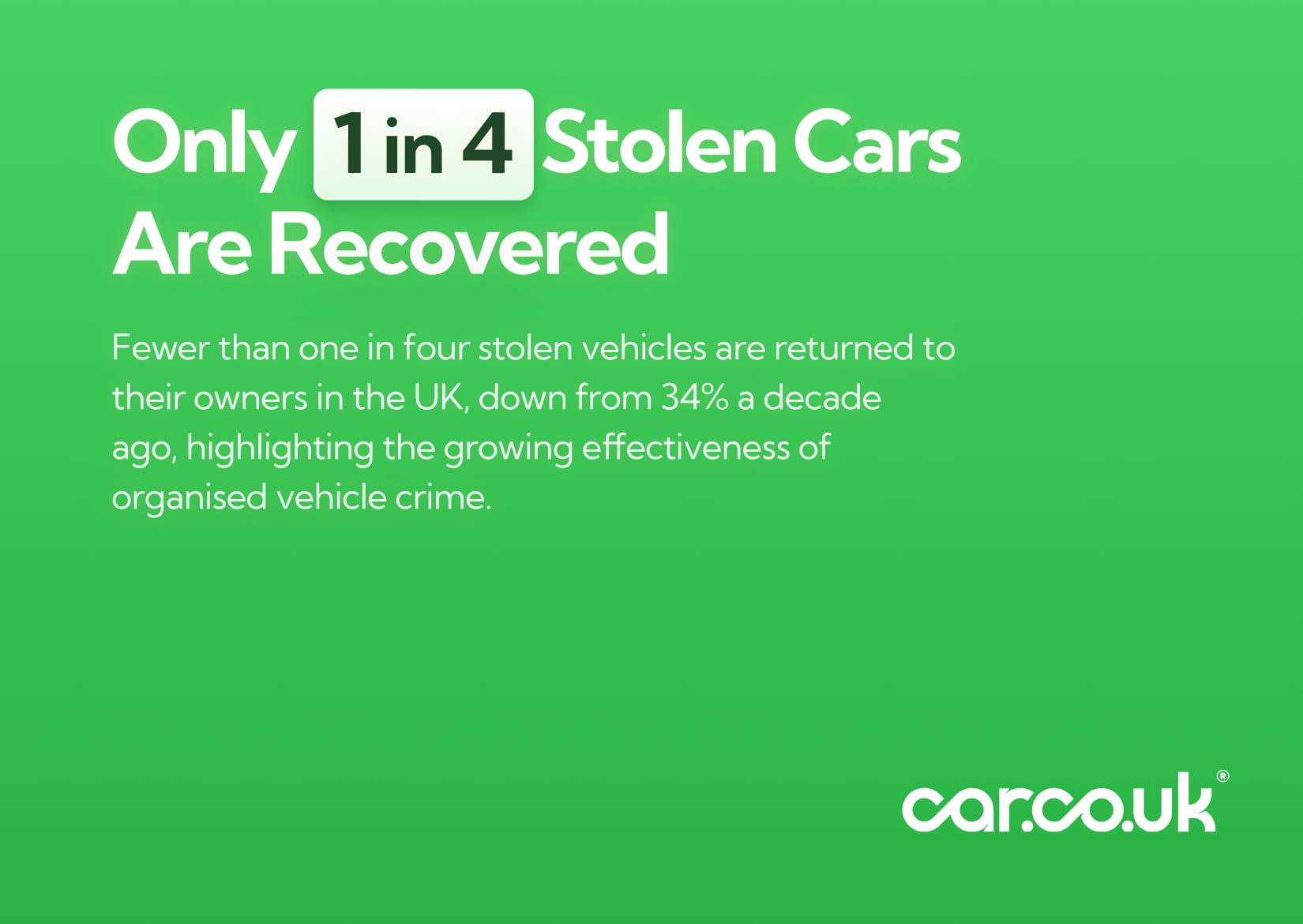
Just 25.6% of stolen vehicles were returned to their owners in 2024-25, which is a decrease from 34% a decade ago and the lowest figure in the ONS CSEW dataset. Another way to put it is that roughly three in four stolen cars never make it back.
London bucks the trend slightly. Met Police FOI data shows a 50.2% recovery rate across the capital (19,826 vehicles returned out of 39,494 stolen). This most likely reflects greater police resource and ANPR camera density.
Of vehicles seized nationally, around 65% are returned to owners, with the remainder destroyed or auctioned.
How long does it typically take for a stolen car to be recovered?
There's no published national average for recovery time, but the window matters enormously. According to a police vehicle crime lead cited in the RUSI 2025 report, a vehicle can be in another county with cloned plates before the owner has even reported it stolen.
GPS-tracked vehicles are recovered significantly faster – in some cases within hours – while untracked vehicles may never be found at all.
Where do stolen cars end up after they are taken?
Increasingly, stolen cars end up overseas after they are taken. RUSI's 2025 report tracked stolen UK vehicles to Cyprus, the UAE and the Democratic Republic of Congo, among many other places.
Dover is a key vulnerability when it comes to this. Ferries depart every 30 minutes, giving criminals a realistic window to move a vehicle out of the country before police have time to react. Criminals also hold vehicles back deliberately, in order to test whether they're being tracked before export, a practice RUSI describes as "cooling off".
Those that stay in the UK are either stripped for parts or resold with cloned identities through online marketplaces. The latter is particularly difficult to police; vehicles and parts are not inherently illegal items, so they circulate freely with limited oversight.
How often are stolen cars used in other criminal activities?
Stolen cars are frequently tied to other criminal activities, and vehicle theft is no longer a low-level opportunistic crime. RUSI's 2025 report describes it as a ‘high-value, low-risk form of serious and organised crime’.
Not only that, it’s one that costs the UK economy £1.77 billion a year and involves OCGs with sophisticated technology, established smuggling routes and international networks. In 1993, a Home Office study found that just 47% of car thieves stole for financial gain. Today profit is the primary motive across the board.
Are stolen cars more likely to be stripped for parts or resold?
Both, depending on the vehicle. Higher-value cars like premium SUVs and executive saloons are typically exported whole or resold domestically with cloned plates and altered identities. Lower-value vehicles are more likely to be stripped, with parts sold through online marketplaces where they blend easily into legitimate secondhand trade.
RUSI notes that because online marketplaces allow parts to circulate freely and vehicles/parts aren’t inherently illegal to sell, they’re extremely difficult to monitor and shut down.
Organised vehicle crime in the UK
As has been established, vehicle theft in the UK is not primarily a crime of opportunity. It’s highly organised, with domestic and international dimensions. Comprehending it requires you to understand the criminal infrastructure behind it.
RUSI identifies four distinct typologies of organised vehicle crime groups operating in the UK:
- Organised fraud and online resale: OCGs securing finance leases on vehicles, altering identities and reselling domestically or abroad.
- Tech-enabled theft-to-order: Groups operating with shopping lists of specific makes and models, using bespoke electronic devices to bypass security systems
- Conventional opportunistic OCGs: Less sophisticated groups targeting unlocked vehicles or using traditional methods such as key burglary
- Export networks: Logistics-focused groups moving stolen vehicles and parts through established international smuggling routes
The level of criminal investment is significant. While bespoke theft devices for higher-end vehicles used to sell for £20,000+ cheaper knockoffs are now appearing in response to the higher demand and growing industry.
Today’s groups carry shopping lists of specific makes and models, steal the vehicles, clone them and export them within a single day. And established port routes in places like Dover are exploited before victims or police can do anything about it.
In response, the UK Government announced a new law banning the possession of vehicle theft equipment including relay devices and signal jammers. This closed a legislative gap that had previously allowed criminals to carry the tools of the trade without criminal liability.
How are cars stolen? Methods of entry
The way people steal cars has changed significantly over the past decade. Relay theft and electronic signal manipulation have gone from zero to the dominant method for whole-vehicle theft, while traditional forced entry has declined.
Most common car theft methods in the UK (2014-2025)
For all vehicle-related theft (including break-ins), the most common entry method remains an unlocked door. It makes up 46.4% of all incidents in 2024-25. This is broadly unchanged for a decade. But as you can tell, for theft of vehicles specifically, the picture is starkly different.
The cost and impact of car theft in the UK
Vehicle theft costs the UK at least £1.77 billion a year in economic and social terms, according to RUSI's June 2025 report. That accounts for the cost to individual victims, insurers, the justice system and wider society. Everyday drivers can feel it most acutely through insurance premiums, which have risen 82% since 2021 with vehicle theft a significant contributing factor.
The individual cost picture from ONS CSEW Table 5 tells its own story. The mean cost of damage from vehicle theft stood at £902 in 2024-25. This is down from a £1,070 peak in 2023-24 but still three times the £314 recorded in 2014-15. The median sits at £200, unchanged since 2022-23.
The shift toward higher cost brackets is clear — the proportion of incidents costing £500 or more has more than doubled over the decade. RUSI puts today’s average individual vehicle cost of theft at £13,603 for private vehicles and £45,927 for commercial vehicles.
How car theft affects your insurance
Most insurers treat theft claims as fault claims – they can't recover costs from a thief – which means losing your no-claims discount. That discount can be worth up to 70% off your premium after years of clean driving, and losing it typically pushes renewals up by 30-60% for the next three to five years.
The wider theft surge is hitting all policyholders too. WeCovr reports insurers paid out £653 million in vehicle theft claims in 2024 (a record high) and those costs feed directly into everyone else's premiums. It's a significant factor behind the 82% rise in car insurance quotes since 2021.
Insurers mainly assess vehicle theft risk on three things: postcode, vehicle make and model and security features fitted. High-theft areas like London, Birmingham and Manchester can add 25%+ to a premium versus a rural equivalent.
On the flip side, a Thatcham-approved tracker or immobiliser can reduce premiums by 5-25%, with combined setups delivering discounts of 12-18%. For high-risk models, some insurers now mandate a tracker as a condition of cover.
UK car theft vs international comparison
The UK's vehicle theft problem is serious, but it sits in the middle of the European pack rather than at the top. At 142 thefts per 100,000 people, the UK ranks 7th in Europe and well behind France, which leads the continent at 248 per 100,000 and recorded over 140,000 vehicle thefts in 2024.
The clearest Europe-wide picture comes from the Center for the Study of Democracy's 2023 report on organised vehicle crime, which reproduces Eurostat 2020 police data across all EU member states. The ranking from lowest to highest runs from Denmark and Romania through to the Netherlands, Italy, France and Sweden at the top. Germany, despite its size, sits comfortably below the UK.
In absolute terms for 2023: France recorded over 140,000 vehicle thefts, Italy 131,679 and Germany around 30,000. The UK's 130,000+ sits between France and Italy by volume, but France and Italy have smaller vehicle fleets relative to population, making their per-capita rates higher.
The criminal infrastructure is pan-European. The CSD report identifies a comprehensive cross-border logistics operation for moving stolen vehicles to destination markets, with Antwerp, Le Havre and Rotterdam the key export hubs for vehicles headed to West Africa and beyond. RUSI's 2025 report corroborates this, tracking UK-stolen vehicles to Cyprus, the UAE and the DRC.
One consistent pattern across all countries: keyless entry vulnerability is the dominant driver of theft growth everywhere, and organised crime groups are exploiting the same techniques and export routes regardless of which country the vehicle was stolen from.
What are the most effective ways to prevent car theft in the UK?
With such a significant number of vehicles stolen in the UK every year and relay theft now accounting for nearly half of all whole-vehicle thefts, passive reliance on factory security is no longer enough. The good news is that layered, affordable security measures significantly reduce your risk.
Now, here are the most effective options, from basic physical deterrents to GPS trackers and keyless-specific protection:
What security devices are most effective at preventing car theft?
Central locking is fitted to 93% of UK vehicles and remains the baseline, but it's the starting point, not the be-all-end-all solution. The most effective security setups combine multiple layers:
- An alarm to alert
- An immobiliser to prevent the engine starting
- A physical deterrent to slow thieves down visually
Each layer alone is defeatable; together they make your vehicle a harder target than the next one along.
Not to mention, a Thatcham-approved immobiliser or tracker is the most impactful upgrade for most drivers, both for theft prevention and because it can reduce your car insurance premiums by as much as 25%.
Which steering wheel locks and physical deterrents work best against thieves?
Brands with Sold Secure or police approval offer the most credible deterrence. And remember that visibility is the point. Steering wheel locks and wheel clamps don't make a car unstealable, they just make it slower and noisier to steal (which is usually enough to push a thief to an easier target).
A few overlooked basics that matter here:
- Never leave your car running unattended (e.g. while defrosting); it can result in both theft and a fine under the Road Traffic Act.
- Don't leave your logbook or service records in the car because they make stolen vehicles significantly easier to resell.
- Park nose-in against a wall or garage door when you can, as this blocks access to headlight wiring used in CAN bus attacks.
How effective are GPS trackers at recovering stolen vehicles?
GPS trackers are highly effective at recovering stolen vehicles. The Met Police FOI data puts London's overall vehicle recovery rate at 50.2%, and GPS-tracked vehicles are recovered at a meaningfully higher rate than that average, typically within hours rather than days. Without a tracker, a vehicle can be in another county with cloned plates before it's even reported stolen.
Thatcham-approved S5 and S7 category trackers are the gold standard. They include 24/7 monitoring and direct police coordination, and many insurers require them as a condition of cover for high-risk models. Data from 2024 shows 95% of vehicles fitted with Thatcham-approved trackers are recovered within 24 hours.
What are the best ways to protect a keyless entry car from relay theft?
Relay theft is fast, silent and requires no physical force, which makes physical awareness your primary defence. The most effective measures against it are:
- Faraday pouch or signal-blocking box: The single most effective and cheapest defence. This blocks the key fob signal completely and costs just £5 to £15
- Switch off your key fob's wireless signal: Many modern fobs allow this; check your manual to see if yours does and how to do it.
- Ghost immobiliser: A covert aftermarket device that prevents the engine starting without a hidden PIN sequence. Relay attacks and key cloning cannot bypass it.
- Steering wheel lock: Relay theft gives criminals a working key signal but a visible lock still slows them down and may push them elsewhere.
- Dashcam with parking mode: A camera that’s visibly recording deters opportunist criminals and provides evidence if theft or damage occurs.
How much can the right security measures reduce the risk of car theft?
The historical evidence is practically irrefutable at this point. The introduction of mandatory electronic immobilisers across Europe in the 1990s produced one of the most dramatic crime reductions ever recorded for a single security measure.
In the Netherlands, immobilisers lowered the overall car theft rate by around 40% between 1995 and 2008, according to a peer-reviewed study published in the Economic Journal. In the US, vehicles fitted with immobilisers were 80% less likely to be stolen than those without.
And in the UK, the likelihood of a vehicle-owning household being a victim of vehicle theft fell by around 80% between 1993 and 2017. This is a reduction the ONS attributes largely to improved vehicle security.
The problem is that keyless entry reversed much of that progress from 2013 onwards by introducing a new vulnerability that standard immobilisers weren't designed to address.
Today, the most effective protection combines multiple layers:
- Ghost immobiliser (prevents the engine from starting)
- Thatcham S5 or S7 tracker (enables recovery)
- Physical deterrents (steering wheel locks, wheel clamps)
- Faraday pouches (block relay signal amplification)
Government and police response to car theft
The Crime and Policing Bill introduced in February 2025 bans the possession, manufacture, sale and supply of electronic vehicle theft devices. That includes signal jammers and relay gadgets.
Previously, police could only prosecute if they could prove a device had been used in a specific crime. The burden of proof now reverses: anyone found in possession must demonstrate a legitimate purpose, or face up to five years' imprisonment and an unlimited fine.
Signal jammers are implicated in 40% of vehicle thefts nationally and around 60% in London, according to Metropolitan Police estimates.
But despite the new legislation, the odds of catching a car thief remain poor:
- Just a 6.7% chance of a car thief being caught.
- Fewer than 1 in 4 thefts are investigated.
- Vehicles can cross force boundaries before police are even notified.
- Port security is focused on imports, with insufficient capacity to examine exported vehicles.
RUSI's June 2025 report identifies three structural failures and calls for:
- A national vehicle crime intelligence hub to map OCG structures, methods and financial flows.
- Preventive action across sectors, not just criminal justice responses.
- Urgent research to fill intelligence gaps on organised criminal networks.
- Cross-sector coordination between police, manufacturers, insurers and port authorities.
Future predictions for car theft in the UK
The headline forecast is modest optimism. Zego projects reported thefts will fall around 2% between 2024 and 2026, and median damage costs are expected to reach £238 by 2026-27. But the underlying picture is more complicated than those numbers suggest.
What the data points toward:
The 2% projected reduction is remarkably tiny relative to the 75% increase over the last decade, and early 2025 DVLA data shows thefts running 48.5% above 2024's daily average in the first seven months. This raises serious questions about whether even that modest forecast holds. To top it all off, the CSEW recovery rate hitting a record low of 25.6% in 2024-25 suggests the criminal infrastructure is becoming more efficient, not less.
The signal manipulation figure dropping from 57.6% to 46.7% of whole-vehicle thefts between 2023-24 and 2024-25 is worth watching… it could indicate the new legislation and manufacturer countermeasures are starting to bite, or it could simply reflect displacement to other methods. The rise of "door not locked" from 5% to 14.5% in the same period may indicate exactly that kind of displacement.
Structural trends likely to shape the next five years:
- EVs as a growing target: As EV adoption grows, battery pack theft and CAN bus vulnerabilities specific to electric platforms will almost definitely attract more criminal attention. The 2025 theft charts already show hybrids overtaking volume petrol models in several categories.
- Continued professionalisation: RUSI is clear that criminal innovation is outpacing manufacturer countermeasures, and that stolen vehicle export routes to West Africa, the Middle East and beyond are becoming more established, not less.
- The equipment ban's real test: Banning signal jammers removes a tool, but not the criminal networks. RUSI's concern is displacement: as one method becomes harder, OCGs with R&D capacity will adapt. The history of vehicle security suggests they pretty much always do.
- Manufacturer divergence: RUSI notes theft reductions are not evenly distributed. Brands that have invested heavily in security upgrades – Land Rover's 77% Evoque theft reduction is the clearest example – are seeing dramatic results. Those that haven't will continue to dominate the most-stolen lists.
The most honest reading of all the data is that the volume of theft may plateau or modestly decline, but the sophistication, export reach and economic damage per incident are all moving in the wrong direction.
About Car.co.uk

Share on
Latest news & blogs