How to Recycle Electric Car Batteries
This guide covers everything you need to know about EV car battery recycling: the rules, the process, where to take your battery and what happens after you take it to the Authorised Treatment Facility.
Last updated: 7th April, 2026

Anthony Sharkey is COO at New Reg Limited (Car.co.uk, Trader.co.uk, Garage.co.uk), driving innovation in vehicle recycling, logistics, and customer experience.
Listen to this story
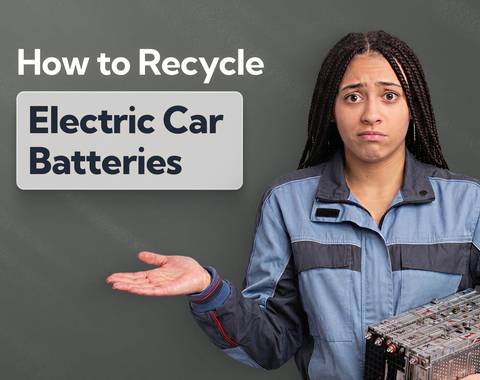
Recycling an electric car battery is nothing like recycling a tin can or a cardboard box. Here in the UK, there’s a proper recycling process EV batteries go through in order to keep nasty chemicals out of the environment and recover valuable materials. In fact, it’s the law.
Certified technicians have to safely remove the pack from the vehicle, transport it to a licensed facility and disassemble it into individual modules and cells. From there, they extract valuable materials like lithium and cobalt, which they feed back into the supply chain, and remove toxic chemicals so they don’t end up in landfill.
Here's how the full process works, step by step.
What's in this article
- 1. 1. Remove the electric car battery safely.
- 2. 2. Drop off the battery at a certified recycling centre.
- 3. 3. Disassemble the battery pack into individual cells.
- 4. 4. Separate and extract the raw materials from cells.
- 5. 5. Process the black mass for material recovery.
- 6. 6. Reuse the recycled materials in new EV batteries.
- 7. 7. Dispose of the remaining waste properly.
- 8. Why recycling electric car batteries is important
- 9. What valuable materials can be recovered from recycling electric car batteries?
- 10. Where can electric car batteries be recycled?
- 11. What are the legal requirements for recycling electric car batteries?
- 12. What happens to electric car batteries after recycling?
1. Remove the electric car battery safely.
Before anything else, the battery needs to come out of the car. To remove the battery, trained technicians follow a strict set of guidelines:
- Isolate the high-voltage system: All power sources get disconnected before anyone touches the pack.
- Discharge the battery: Any remaining stored energy has to be removed first.
- Use the right protective gear: Insulated gloves, face protection and specialist high-voltage tools throughout.
- Follow manufacturer guidelines: Every battery pack is built differently, so model-specific procedures matter.
- Secure for transport: Once removed, the pack has to be handled and transported in line with hazardous materials regulations.
EV battery packs run at high voltage, so getting any of these wrong risks electric shock, toxic gas release or thermal runaway (where the battery overheats uncontrollably and catches fire).
2. Drop off the battery at a certified recycling centre.
You can't take an EV battery to a regular old recycling centre. It must go to a facility with trained staff, specialist equipment and hazardous waste licences to handle EV batteries.
In the UK, the main routes are:
- Your manufacturer or dealer: All EV manufacturers in the UK are legally obligated to have battery take-back schemes and handle end-of-life batteries. Your first call should be to the dealership or manufacturer directly.
- A licensed ATF: If you’re going to scrap your car instead, it legally has to go through an Authorised Treatment Facility licensed by the Environment Agency. You can check whether a facility is registered via the EA's public register.
- Specialist EV battery recyclers: Companies like Recyclus and Ecobat operate dedicated collection and processing services across the UK.
The legal framework sitting behind all of this is the Waste Batteries and Accumulators Regulations 2009, which makes manufacturers and importers responsible for facilitating proper collection and recycling, and prohibits consumers from disposing of batteries in general household waste.

3. Disassemble the battery pack into individual cells.
Once the battery arrives at a certified facility, technicians strip it down, first into modules, then into individual cells.
Disassembly matters for two reasons:
- Second-life assessment: Individual cells still holding useful charge can be repurposed for energy storage rather than going straight to shredding.
- Safe downstream processing: Shredding an intact battery pack dramatically increases the risk of thermal runaway during the next stage.
This is still largely a manual process, because no two battery packs are built the same way. The equipment involved includes insulated tools, high-voltage PPE and, in some facilities, robotic assistance for the most dangerous disassembly steps.
Cells that can't be repurposed go into industrial shredders.
4. Separate and extract the raw materials from cells.
Before shredding, the cells get fully discharged to eliminate residual electricity. Then technicians (or increasingly, robots) remove the outer casing, internal wiring and the battery management system before anything goes near a shredder.
Lithium-ion cells are volatile, and shredding them in open air is a serious fire risk. So facilities either flood the environment with an inert gas like nitrogen or CO2 to displace oxygen, or run the process in a wet environment using water or specialised brine to prevent a reaction.
What comes out the other side is:
- Black mass: The most valuable output; a fine dark powder carrying the cathode and anode materials including lithium, cobalt, nickel, manganese and graphite.
- Copper and aluminium foils: Pulled out using magnets, sifters or shaker tables.
- Plastics and steel: Casing fragments and separator materials that go into standard recycling streams.
- Electrolyte: Recovered by evaporating and condensing the liquid in heated or vacuum-sealed systems.
5. Process the black mass for material recovery.
Since black mass is a mixed powder with multiple metals all bound together, you can’t use it in its raw form. There are two main methods for extracting its valuable materials:
- Pyrometallurgy: High-heat smelting that melts the material down and separates metals. It's well-established but energy-intensive, and it tends to lose lithium and graphite in the process.
- Hydrometallurgy: Chemical leaching using solvents to dissolve and separate individual elements. It's more precise and recovers a wider range of materials, so it’s increasingly the preferred approach for EV battery recycling.
The recovered lithium, cobalt, nickel and manganese go back into the supply chain as inputs for new battery production.
6. Reuse the recycled materials in new EV batteries.
Once refined to sufficient purity, recovered metals re-enter the battery supply chain as precursor materials.
Nickel, manganese and cobalt get combined through a process called co-precipitation to produce cathode precursor material. This is the same starting point used in conventional battery manufacturing.
Then, lithium gets added at the calcination stage to produce the finished cathode active material. The end result is chemically equivalent to what you'd get from freshly mined metals.
That's the whole point of the recycling process. These are finite, expensive, largely imported minerals and recovering them domestically reduces dependence on new mining.
7. Dispose of the remaining waste properly.
Not everything that comes out of the recycling process has a second life. A few things you cannot recycle:
- Degraded plastics
- Contaminated separator films
- Processing residues
- VOC emissions
Certified facilities capture VOCs through filtration and thermal treatment systems, while solid residues get classified and handled as hazardous waste under the Environmental Permitting Regulations 2010.
Landfill and incineration are both banned for EV batteries and their derivatives under the Waste Batteries and Accumulators Regulations 2009, so licensed facilities have to route residual waste through approved hazardous waste disposal channels (hence why using a licensed centre matters at every stage of the process).
Why recycling electric car batteries is important
EV adoption is accelerating fast, with 19.6% growth in new registrations in 2025, according to our new car sales data. As more people go electric, the wave of end-of-life batteries that follows is only going to grow.
Getting recycling right (or wrong) has serious consequences for the environment, for the economy and for the long-term viability of the EV transition itself.
Here's why it matters:
- Reduces EV battery waste: Without proper recycling infrastructure, end-of-life packs would pose serious risks to soil and water through toxic chemical leakage. Recycling offers a way to repurpose the materials instead of letting them end up in landfills.
- Conserves lithium and cobalt: Both lithium and cobalt are finite, expensive and largely imported. Recovering them domestically reduces dependence on mining imports and keeps critical minerals circulating in the supply chain.
- Minimises hazardous chemical exposure: EV batteries contain toxic compounds like fluorinated electrolytes and nickel oxides. Improper disposal leaches these into soil and groundwater, which destroys local ecosystems and harms human health.
- Supports electric vehicle sustainability: Recycling each tonne of lithium requires a fraction of the water and energy needed to mine it from scratch. This directly reduces the carbon footprint of new battery production.
- Reduces raw material mining: Recovered materials feed straight back into new battery manufacturing, reducing the need for virgin raw materials and making the EV supply chain more self-sufficient over time.
- Lowers new battery production costs: Since they don’t require new mining, recycled materials are cheaper to process. As recycling scales up and recovery rates improve, the lower costs of producing new EV batteries will make EVs more affordable.
What valuable materials can be recovered from recycling electric car batteries?
Six key materials can be recovered from a recycled EV battery: lithium, cobalt, nickel, manganese, graphite and copper.
Here's what each one is used for:
- Lithium: This is the core element in both the cathode and electrolyte of every lithium-ion battery. And since recovered lithium goes straight back into new cell production, recycling helps secure a steady supply while reducing the need for new mining.
- Cobalt: Cobalt is one of the most valuable (and geopolitically sensitive) materials in the supply chain. As it’s primarily sourced from the Democratic Republic of Congo, recycling provides a more sustainable and ethical way to access it.
- Nickel: A key ingredient in high-energy-density NMC cathodes used in modern EVs. High recovery rates make it one of the most economically valuable outputs of EV battery recycling.
- Manganese: This metal gets used alongside nickel and cobalt to balance stability, energy density and cost in NMC battery chemistry. EV battery tech is shifting towards manganese-rich chemistries, so recovery is critical to bridge supply-demand gaps.
- Graphite: Graphite makes up 10-20% of an EV battery by weight – significantly more than lithium – and forms the anode that stores and releases charge. China controls the vast majority of global graphite supply, making recycled graphite an increasingly strategic material.
- Copper: Copper gets recovered as foil from the anode current collector. Unlike most battery materials, it doesn't degrade during use, which means recovered copper retains full material quality and can go straight back into battery or general manufacturing without further refinement.
Where can electric car batteries be recycled?
In the UK, the law requires that EV batteries go through facilities licensed to deal in hazardous waste. The main routes are via your manufacturer, an Authorised Treatment Facility (ATF), or a specialist recycler.
Here's where to look:
- Certified EV battery recycling centres: Licensed by the Environment Agency under the Environmental Permitting Regulations 2010, these facilities have the trained staff, specialist equipment and hazardous waste authorisation to safely disassemble, shred and process battery packs. They're legally required to maximise material recovery and minimise environmental impact – i.e. they follow the full process from discharge through to black mass refining.
- Authorised EV manufacturers and dealerships: All auto manufacturers have battery take-back obligations, so they each run their own end-of-life programmes in partnership with specialist recyclers. Nissan, for example, works with Ecobat to recover and repurpose batteries from retired LEAFs. If you're replacing a battery or scrapping an EV, your dealership is the most straightforward first call. And they’ll normally be able to arrange collection or drop-off without you having to find a facility yourself.
- Local waste management facilities: Some local authority household waste recycling centres (HWRCs) accept EV batteries, but not all are equipped or authorised to. Before turning up, verify that the facility holds the proper licensing (which goes beyond the waste carrier’s licence and environmental permit), explicitly accepts EV lithium-ion batteries and has a downstream arrangement with a certified recycler. Contact your local council or check the Environment Agency's public register to confirm before making the trip.
- Specialised battery recycling companies: Dedicated EV battery recyclers like Collect and Recycle, Recyclus and Ecobat operate nationwide collection and processing services with the equipment and expertise to handle lithium-ion packs specifically. Unlike general waste contractors, they’re set up for the full process and can handle damaged, degraded or unknown-state batteries that other facilities won't touch. Most offer business collection services; some work directly with private individuals too.
- Registered car breakers and salvage yards: Car breakers and salvage yards dismantle end-of-life vehicles and recover usable parts. Many of them are licensed to handle end-of-life EVs specifically, including battery removal and disposal. Not all are set up for it, though, so it's worth confirming before you turn up. If they are, it's the most convenient route if your plan is to scrap your old EV outright.
What the experts say

Steven Jackson OBE

What are the legal requirements for recycling electric car batteries?
UK law makes it illegal to send EV batteries to landfill or incinerate them, requires manufacturers and importers to finance their collection and recycling, and mandates that any facility handling them holds a permit. Consumers can't legally dispose of them in household waste, and businesses have to use registered waste carriers and licensed facilities.
Four key pieces of legislation govern EV battery recycling in the UK:
- Waste Batteries and Accumulators Regulations 2009: The core law stating that manufacturers, importers and anyone else putting batteries on the UK market for the first time carries legal responsibility for what happens to them at end-of-life. It requires them to register with the Office for Product Safety and Standards and cover the cost of collection and processing.
- Environmental Permitting Regulations 2010: Recycling and treatment facilities need a specific Environment Agency (or equivalent in Wales, Scotland or NI) permit to legally handle battery waste. No permit means no authorisation, which is why unlicensed operators simply can't be used.
- End-of-Life Vehicles Regulations 2003: Like any other ELV, scrapping an EV isn't a free-for-all. The vehicle has to go through an Authorised Treatment Facility, with battery depollution carried out by a licensed operator before anything else happens.
- Batteries and Accumulators (Placing on the Market) Regulations 2008: This covers what can and can't go into batteries sold in the UK, including hazardous substance limits and labelling obligations.
What happens to electric car batteries after recycling?
Once processed, the materials recovered from an EV battery feed directly back into manufacturing, either as inputs for new batteries or as raw materials for other industries.
Let’s have a look at where each one ends up:
- Reused in new EV batteries: Refined lithium, cobalt and nickel go back into cathode precursor production, where they're combined in precise ratios to manufacture new battery cells. Chemically, recycled materials are as good as new; they perform identically to freshly mined equivalents. Thanks to this, manufacturers can sub them directly into existing production processes. As recycling scales up, recovered materials are expected to cover an increasingly large share of the UK's battery manufacturing demand.
- Repurposed for energy storage: Batteries which still hold useful charge get a second life in stationary energy storage before they're taken to the shredder. Home solar storage, grid-scale backup systems and power supplies for hospitals, data centres and events are all viable applications. A battery that's too degraded for an EV (typically below 70-80% capacity) can still deliver another 10 to 15 years of useful service in a less demanding fixed installation like these.
- Metals are sold to manufacturers: Because they’re refined to battery-grade or industrial-grade purity, these materials get traded as commodities and sold directly to manufacturers across the supply chain. Cobalt and nickel feed into electronics and aerospace components; copper goes into wiring and electrical equipment across multiple industries; lithium has applications in ceramics, glass and pharmaceuticals.
- Non-recyclable waste disposed safely: Landfill and incineration are both banned for battery-derived waste, so certified facilities are legally required to find compliant disposal routes for everything that comes out of the process. For plastics, contaminated separator films and processing residues the facility can’t recover, they’re routed through separate disposal channels. For the VOCs produced during shredding, they get captured via filtration and thermal treatment systems.
- Reduces the need for mining: Every tonne of lithium, cobalt or nickel you recover from a recycled battery is a tonne that doesn't need to be extracted from the ground. Mining these materials is extremely energy-intensive and carries serious environmental and human rights risks. As domestic recycling scales up and recovery rates improve, recycled materials will cover a growing share of the UK's battery supply chain demand. This will be better for EV prices and the local economy, but also for the ecosystems and populations in the areas exploited by mining operations.
Electric car battery recycling FAQs
Most EV batteries are designed to last between 10 and 20 years, or roughly 100,000 to 200,000 miles (whichever comes first). Most manufacturers guarantee at least 70% capacity retention over 8 years or 100,000 miles. But in practice, how fast an EV battery degrades depends heavily on the driver’s charging habits, climate and usage patterns.
When a battery drops below that threshold, it's typically replaced rather than outright scrapped. The reason for this is that even if it’s no longer fit for EV usage, it still has enough capacity left for a second life in energy storage.
As of 2026, processing costs for EV battery recycling currently sit somewhere in the range of £5 to £10 per kilogram for facilities handling collection, disassembly and material separation. The exact figure varies significantly depending on battery chemistry, condition and which recycling method is used.
For the average driver, though, the cost is effectively nothing. Manufacturers are legally obligated to finance end-of-life battery collection and recycling, and certified facilities are incentivised to take batteries because of the value of the materials inside. Nobody expects you to arrange hazardous waste transport yourself.
EV batteries can be reused before recycling, and in most cases it's the preferred option. When a battery drops to 70-80% of its original capacity, it's no longer ideal for powering a car but still has plenty of life left for less demanding applications.
Stationary energy storage is the most common second-life use. Home solar storage, grid-scale backup systems and power supplies for commercial buildings and data centres are the three basic examples of this. A battery in this kind of role can deliver another 10 to 15 years of useful service before it needs to go through the recycling process.
Generally, it is not safe to store an old EV battery at home without specialist training, proper equipment and fire suppression systems in place. EV batteries carry serious risks of thermal runaway, toxic chemical leakage and fire, particularly if the pack is damaged or in an unknown state of charge.
If storage is absolutely necessary, you’ll need a detached, well-ventilated space that’s away from the main property. This is the minimum requirement. In practice, the safest and most practical option is to get the battery to a certified facility as quickly as possible rather than storing it at all.
About Car.co.uk

Share on
Latest news & blogs