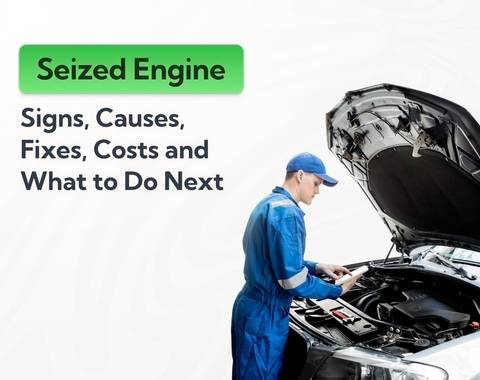
Seized Engine: Signs, Causes, Fixes, Costs and What to Do Next
A seized engine is one of the worst things that can happen to your car, but it doesn’t always mean game over. This guide breaks down what causes engine seizure, how to spot the signs, what your repair and replacement options look like and when scrapping is the smarter move.
Last updated: 3rd November, 2025

Award-winning automotive entrepreneur, tech innovator, and founder of Car.co.uk, NewReg.co.uk & Recycling Lives.
Listen to this story
Let’s not sugarcoat it. If your engine’s seized, you’re in trouble. Big trouble. We’re talking worst-case scenario level trouble.
]A seized engine means the internal moving parts have stopped moving completely, and they’re not going anywhere without serious help. You turn the key, and… nothing.
]So, how does it happen?
Usually, it’s oil. Or more specifically, lack of oil. That magical golden fluid is the only thing standing between your engine’s metal parts and catastrophic self-destruction. Take it away (or let it run too low for too long), and things heat up, warp and weld themselves together.
If you’re in this position, you’re looking at a big decision. Is it worth fixing? Is it even fixable? Or is your car now just a very expensive paperweight?
What's in this article
What causes an engine to seize?
An engine seizes when the metal components inside it can’t move freely anymore, usually because they’ve overheated, warped or fused together. 9 times out of 10, this is because of an oil-related issue.
Let’s take a closer look at the exact causes of engine seizure.
Lack of engine oil
When there’s not enough oil to lubricate the engine components, it creates friction. As metal parts grind together in ways they’re not supposed to, heat starts to build up. Eventually, the heat is so great that the parts weld together.
This is one of the easiest issues to prevent, too. Keep your oil topped up and stick to regular oil changes every 5,000 to 7,500 miles and you’ll have nothing to worry about here.
Using old or sludgy oil
Over time, engine oil breaks down. As it collects dirt, metal shavings and carbon deposits, it loses its ability to lubricate. Eventually, it thickens into sludge, which doesn’t flow through the engine properly.
Sludgy oil can’t reach the tight tolerances in the engine where it’s needed most. That means dry friction builds up in areas around the bearings, camshafts and piston rings, and that’s where things start to go wrong.
So even if your oil level looks fine, old oil can be just as dangerous. If you were to only keep topping it up instead of going in for an actual change, the oil that’s meant to protect your engine would end up choking it instead.
Overheating the engine
Engine overheating has tons of causes:
- Coolant leaks or low coolant level
- Faulty thermostat
- Broken water pump
- Blocked radiator
- Cooling fan failure
- Driving with low oil
- Ignoring the temperature warning light
When the engine gets too hot, the oil starts to break down. When there’s no film of oil between the engine components, friction begins to create extreme temperatures, which in turn cause the metal to expand. Eventually, parts warp and fuse together, particularly inside the cylinders where tolerances are tight. Once the metal’s deformed, there’s no going back.
Mechanical failure
If a key internal part like a piston, valve or connecting rod breaks, it can jam the engine and stop the crankshaft from turning. Common failures include snapped timing belts or chains, broken connecting rods, dropped valve seats and spun bearings. These kinds of things normally happen from age, over-revving, detonation, overheating or poor engine maintenance.
Warning signs to look for here include knocking sounds, metal in the oil, low oil pressure and sudden loss of power. Once a component fractures inside the block, damage spreads quickly, often leading to a full seizure or total engine rebuild.
Hydro-lock (hydraulic lock)
Engines don’t compress liquids. So if water, coolant or fuel floods into the combustion chamber and there’s nowhere for it to go, the piston hits a wall it can’t move past. That’s called ‘hydro-lock’.
This happens when a car drives through deep water, or if a blown head gasket lets coolant into the cylinder. Over time, or if the leak is significant enough, liquid builds up in the cylinder. This causes the pistons to stop and the connecting rod to bend or break.
Rust or corrosion
Engines are made of metal. Leave them sitting for too long in damp or poorly ventilated conditions and like anything else, they’ll start to rust. It might not look dramatic from the outside, but inside, it’s what’ll keep your engine from working properly next time you turn the ignition.
When this happens, the piston rings can stick to the cylinder walls, bearings can seize and valves can corrode in place. And the longer it sits, the worse it gets.
This kind of seizure ironically doesn't come from use; it comes from neglect. Which is why any car going into long-term storage needs to be prepped properly, with the engine turned over occasionally and moisture kept well away.
Signs that your engine might be seized
If your engine is seized, it’s not going to move any longer. And not in the usual flat-battery, maybe-it’ll-go-on-the-second-try kind of way. I’m talking zero movement. This can happen while you’re driving or it could surprise you when you’re starting the car.
So you’ll know immediately that something’s wrong. Let’s take a look at the signs that seizure is the issue at hand.
Engine won’t crank
If you turn the key and the engine doesn’t crank (no turnover, no movement) that’s a big red flag. A seized engine physically can’t spin, so the starter motor either clicks or does nothing.
Start by ruling out the basics. If your lights, radio and dashboard still come on, the battery isn’t the problem. You can also try jump-starting it. If it still won’t crank and the starter and wiring check out, you’re dealing with a seized engine.
Knocking or clunking noises
If you heard engine knocking, clunking or a loud metallic bang before the engine cut out, that’s a sign something’s broken inside. It could be a snapped con rod, dropped valve or a piston that’s gone sideways. Those kinds of failures usually don’t happen quietly.
Other sounds might include grinding, tapping or a sudden backfire.
To pinpoint seizure, the sound is just one part. If the noise was followed by total engine failure and the electrics are fine, you can be pretty much certain the engine’s seized from internal mechanical failure.
Dashboard lights on, engine unresponsive
Like I’ve already touched on, if your dash lights up, it means the battery’s working and power is getting to the car. When your engine’s seized, the battery will still work, but it’ll be impossible for the engine to start turning.
So even though the starter tries to engage, there’s nowhere for that energy to go. That “power on, engine dead” mismatch is often the moment drivers realise it’s not just a flat battery.
Sudden engine shutdown
It’s possible for an engine to cut out without warning. One second you’re driving and the next, the engine just stops. This usually means something catastrophic happened inside:
- Oil starvation
- Severe overheating
- Destroyed engine components
- Mechanical failure
- All of the above
If the engine locks mid-cycle, it can be dangerous. The car’s momentum will carry you a bit further, but steering and braking will become a lot more difficult thanks to the loss of power assistance. You’ll hear loud knocking and grinding noises as well.
Burning smell or smoke
If you smell a thick, acidic or smokey burning smell, or you see smoke coming from under the bonnet, pull over immediately. That’s a sign of extreme heat inside the engine, either from friction or failing internal components.
If your car hasn’t lost all power already, it’s probably very close at this point. Leave it alone and this heat will warp parts (if it hasn’t already) and lead to a full seizure.
Engine won’t turn over
Cranking is when the starter motor turns the engine. Turning over manually means physically rotating the crankshaft using a wrench or breaker bar. If the engine won’t budge either way (even with the plugs removed), it’s seized solid.
That’s your confirmation. Nothing inside is moving because something’s locked it in place.

How to fix a seized engine?
How to go about fixing a seized engine depends entirely on what caused it and how bad the damage is. Sometimes it’s surface-level: stuck rings, old oil, a bit of heat damage. Other times, internal parts are completely shattered or welded together.
So before you do anything, you need to figure out what kind of seizure you’re dealing with.
Rebuild the engine.
If the damage is minor, like a stuck piston ring or mild cylinder scoring, an engine rebuild might save it. That means taking the engine apart, cleaning and machining the components and replacing worn or damaged parts.
The process usually involves:
- Removing the engine block
- Stripping it down completely
- Checking tolerances
- Replacing gaskets, bearings, rings, sometimes valves or pistons, and reassembling it to factory spec (or better).
It’s not a small job. Labour alone is incredibly high (though cheaper than a replacement) and if the crankshaft or block is damaged, even more so. But if the rest of the car is in good shape (low miles, decent body, solid gearbox) a rebuild can give it another 100,000+ miles.
Check for broken parts.
Before you throw money at a rebuild or replacement, you need to know what you’re working with. That means physically inspecting the engine for damage, and not just a quick peek under the bonnet. Here’s how to go about it:
- Remove the spark plugs. Start simple. Take out the plugs to relieve cylinder pressure. If any look soaked in oil or damaged, that’s your first clue something’s gone wrong inside.
- Try to turn the engine by hand. Use a socket and breaker bar on the crankshaft pulley. If it won’t budge even after soaking the cylinders with penetrating oil, the seizure is likely mechanical, not just surface rust or old oil.
- Pull the cylinder head. This is where you get answers. Look for broken valves, scored cylinder walls, or damaged pistons. Any visible cracks or chunks missing means deep internal failure — and likely rules out a simple fix.
- Check the oil and coolant. Milky oil can mean a blown head gasket. Large metal shavings or chunks in the oil? That’s bearing or internal component failure. Coolant in the cylinders points to hydro-lock or gasket issues.
- Inspect the crankshaft and connecting rods. This part may require dropping the oil pan. Look for bent rods, seized bearings, or any signs the crank isn’t rotating freely.
Spotting the problem early tells you whether a rebuild is worth trying or if the damage is too far gone. It’s the line between a £2,000 repair and a £5,000 replacement.
Add oil and try to free it.
If the engine seized from rust or oil sludge that didn’t cause deeper damage, you might be able to free it with penetrating oil or engine-specific lubricants. If that’s the case:
- Remove the spark plugs.
- Add the penetrating oil into the cylinders.
- Let it soak for several days (or weeks) to fully dissolve the rust or sludge.
- Gently try to rotate the crank by hand using a socket and long-handled breaker bar.
- Reapply and repeat if the engine doesn’t fully break free.
- Use a product like Sea Foam to flush your whole system to get rid of the last remaining contaminants.
- Change the oil and the oil filter.
- Test the car.
But, and this is key, if it seized while driving, chances are the damage is mechanical and oil won’t undo that. This is only a solution for minor failure caused by rust or sludge, not catastrophic failure.
Replace the engine.
Replacing the engine is usually the best option when the damage is severe, like a cracked engine block, snapped rods, seized crankshaft or anything that’s destroyed the internal structure. At that point, rebuilding is expensive and, more importantly, pointless.
You’ve got a few options when it comes to replacement:
- New engine: Rare, and often not worth it unless it’s a high-value car. This is the most expensive route by far.
- Reconditioned engine: A rebuilt unit with new or refurbished parts. More affordable than new, with some warranty protection.
- Used engine: Pulled from a car breaker’s yard or donor car. Cheapest option, but higher risk and usually no guarantees.
Cost-wise, you’re looking at several thousand pounds including parts labour, but that might still be a lot less than replacing the car outright. The decision really comes down to the vehicle’s condition, mileage and value after the fix, which I’ll get to in a bit.
Cost to repair or replace a seized engine
Fixing a seized engine is… not cheap. In fact, it’s almost definitely the most expensive repair your car will ever need.
A basic repair might cost £1,000 to £2,500 if the damage is minor and caught early. But a full engine rebuild? That’ll easily push the bill to £2,000, £3,000 or more, depending on the car. And replacements go above £4,000 all the time.
The final cost depends on what caused the seizure, how much internal damage there is and whether you go for a rebuild, a used engine or a factory-reconditioned one. Labour plays a big role too, since engine jobs are time-intensive.
Cost of repairing or replacing a seized engine (UK, 2025)
Cost of replacing a seized engine
Replacing a seized engine is a major job and the costs reflect that. On average, you’re looking at anywhere from £2,500 to £8,000+ depending on the car and the type of engine you’re fitting.
Labour costs add a big chunk to the cost. Swapping an engine takes 10 to 20 hours depending on the complexity of the job. With hourly rates ranging from £50 to £140 across the UK, that’s an extra £500 to £2,800 just in labour.
On top of that, costs going into it might include fluids, gaskets, filters, ECU reprogramming and additional parts if your old components (like injectors or turbo) were damaged during the failure.
All in all, here’s how it breaks down:
- Used engines (from breakers or donor cars) start around £500 to £3,000. They’re the cheapest option, but they also carry the most risk. There’s usually no warranty and you have no idea how well the engine was maintained.
- Reconditioned engines are professionally rebuilt units with new bearings, gaskets and seals. They typically run £1,500 to £5,000 depending on the make and model. These usually come with limited warranties and are a safer bet than used ones.
- Brand new engines are rarely used for typical repairs unless it’s a valuable or nearly-new vehicle. If this is what you want, expect to pay £3,000 to £8,000 or more with labour included.
Cost of repairing a seized engine
The reality is this varies dramatically based on how serious the issue is and what's still salvageable. Repairing a seized engine can cost anywhere from £800 to over £3,000 and it all depends on the damage.
If it’s surface-level (like mild scoring), you might get away with freeing it up and replacing a few key components. But if internal parts are broken, cracked or warped and you need a full rebuild, it’ll be well into the four figures.
Here’s a rough breakdown:
- Labour: A full teardown and rebuild takes 15 to 30+ hours. At typical UK labour rates (£50 to £140/hour), that’s £750 to £2,000+ just in labour time.
- Parts: Gaskets, rings, bearings, valves and machining work might add £500 to £1,200 depending on what’s needed.
- Machining costs: If you do need a full rebuild, things like cylinder honing, crankshaft grinding and head resurfacing will run another £100 to £500.
- Extras: Add coolant, oil, filters and specialist work like reboring or head skimming.
In theory, repairing your engine is cheaper than replacing it, but that only applies if the damage is limited. If the block is cracked, the crankshaft is ruined or the oil system is contaminated, it’s not worth the risk.
What the experts say

Anthony Sharkey

Is it worth fixing a seized engine?
Truth is, there’s no one-size-fits-all answer. If the rest of the car is in great condition, the engine is generally repairable at an affordable price. But if there’s already serious damage under the bonnet, you’re looking at a massive bill with no guarantee it’ll hold up long term.
The key is weighing the repair or replacement cost against the car’s actual value.
When it’s worth repairing a seized engine
If the damage is limited (e.g. light surface rust from long-term storage), repair is almost always possible. In these cases, the internals are still intact, they’re just gummed up or dried out.
It’s only worth repairing if:
- The car’s in good overall condition.
- The issue didn’t happen while driving (i.e. no signs of internal breakage).
- You can confirm the engine turns freely after lubrication and basic checks.
But let’s be clear: anything involving damaged pistons, spun bearings, worn piston rings or any other kind of serious damage puts you into rebuild territory, which is not a minor job whatsoever. At that point, it’s probably not worth saving.
When it’s worth replacing a seized engine
If the damage is severe but the rest of the car is solid, a replacement engine might be a smart investment. Keep in mind that ‘solid’ means low mileage, good bodywork, a clean MOT history and at least five years of useful life ahead of it.
It’s also a better bet if you can source a reconditioned or used engine at a fair price, and the car has plenty of life left otherwise. This is particularly the case for high-spec, newer and enthusiast models where resale value justifies the expense.
When scrapping your car is the best option
Since engine replacements are so expensive, the numbers just don’t stack up a lot of the time. If…
- The repair or replacement cost exceeds 50% of the car’s value
- The vehicle has high mileage and other known issues
- It’s a decade or more old and nearing the end of its useful life
- You’re facing additional work like gearbox repairs, rust or electrical faults
…it’s smarter to cut your losses. Even if you have a somewhat new car, if it’s worth £8,000 but the mechanic quotes you £5,000 for the replacement, you’re better off giving it up.
Scrap your car with us and you’ll get instant cash, avoid ongoing headaches and move on without sinking money into a lost cause.
How to prevent engine seizure
In my experience, most seized engines don’t fail out of nowhere. They fail because something was neglected. Whether it’s oil, cooling or storage, small oversights add up. The good news? With a bit of regular maintenance and common sense, engine seizure is almost always preventable.
Regular oil changes
Fresh oil is your engine’s first line of defence. It keeps everything lubricated, cool and moving freely. So always stick to the service schedule (5,000 to 7,500 miles for most cars) or change your oil sooner if you do a lot of short trips, towing or hard driving.
Proper cooling system maintenance
Here’s what to do:
- Check coolant levels regularly (low coolant = risk).
- Inspect hoses for cracks, swelling and leaks.
- Make sure the radiator isn’t clogged with debris.
- Listen for odd noises from the water pump (whining or grinding is a bad sign).
- Confirm the fan kicks in when the engine gets hot.
If you notice fluctuating temperature readings, coolant leaks under the car or the heater blowing cold when it shouldn’t, those are signs your cooling system needs attention.
Avoiding overheating
If your temperature warning light comes on, stop driving. Pull over, let it cool down and check for obvious issues like low coolant or leaks. Driving with an overheating engine is a guaranteed way to warp components and lock things up.
As for staying ahead of it:
- Top up coolant regularly and use the correct mix for your car.
- Keep an eye on the temperature gauge. If it starts creeping up, don’t ignore it.
- Check radiator fans are kicking in when the engine gets hot. If they’re not, something’s off.
- Inspect for leaks under the car after parking. Puddles of coolant usually mean trouble.
Use quality engine parts and fluids
Cheap oil, knock-off filters and aftermarket replacement parts will cause real damage over time if they don’t work how they’re supposed to. Always use oil, coolant and internal components that meet your car manufacturer’s spec. Cutting corners here to save £20 will cost you thousands later if it leads to oil starvation or heat issues.
Avoid long-term storage without maintenance
Cars hate being left to sit. If you’re storing a vehicle for months (or longer), start it regularly, keep the battery healthy and turn the engine by hand if possible. That’ll prevent most of the rust, corrosion and internal parts seizing in place.
Frequently asked questions
Yes, but not as a working part. Instead, you’d sell the vehicle with the seized engine to a scrap yard or breaker through our nationwide network, or to a private buyer who wants it for parts. You’d be surprised; if there are other valuable parts, you might be able to squeeze out more than you initially thought.
If the seizure is minor, like from sitting unused, it might be freed with lubrication and time. But if it seized while running, due to heat or mechanical failure, starting it again isn’t likely without major repair or replacement.
No. A seized engine won’t turn, so the car won’t start or run at all. It’s completely immobilised. Towing is your only option at that point.
Yes. Low-quality oil, old sludge and oil starvation due to a bad oil pump can all lead to engine seizure even if the dipstick shows there’s enough oil in there. It's not just about having oil, it's about having clean, circulating oil.
Sometimes. If the cause was surface-level and caught early, you can probably get it running with a few basic fixes and replacements. But most seized engines won’t run again without major work. You’ll need to open it up, assess the damage and rebuild the engine to get it going.
About Car.co.uk

Share on
Latest news & blogs