Catalytic Converter Failure: Symptoms, Causes and What to Do
Catalytic converter failure leaves you stuck with expensive repairs and a car that’ll fail its next MOT. Know the warning signs, common causes and prevention strategies and you’ll catch the problem early enough to avoid that. This guide shows you all of that, plus what to expect when repairs become necessary.
Last updated: 17th January, 2026

Award-winning CEO driving growth and social impact across automotive, recycling, and technology-led enterprise platforms.
Listen to this story
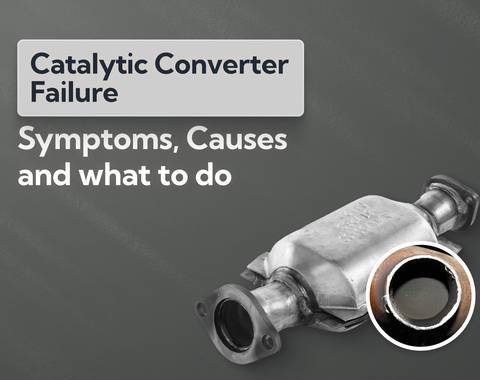
The catalytic converter sits in your exhaust system, quietly cleaning up harmful carbon monoxide, nitrogen oxides, and hydrocarbon gases before they leave the tailpipe.
Since it’s critical to your car’s exhaust flow, vehicle performance suffers dramatically when it starts to fail. Fuel economy drops. You’ll fail your MOT. And from an environmental standpoint, you're essentially driving around with your emissions controls switched off.
The good news is, catalytic converter failure doesn't happen overnight. And the warning signs are usually pretty obvious (like a rotten-egg smell from the exhaust). Knowing the likely causes and repair costs puts you back in control.
In this guide, you’ll learn the most common reasons catalytic converters fail, the early signs to watch for, and what you can realistically expect to pay to fix the issue.
What's in this article
Why are catalytic converters important?
Catalytic converters matter because they’re the part that keeps your car’s emissions in check. Strip it away and you're looking at emission levels roughly 90% higher than what comes out of a properly functioning exhaust system.
The environmental impact is straightforward: catalytic converters neutralise the nastiest components of your exhaust by converting them into less harmful chemicals using platinum, palladium and rhodium as catalysts.
- Carbon monoxide, which is lethal in enclosed spaces, gets converted to carbon dioxide.
- Nitrogen oxides, which contribute to smog and acid rain, are broken down into harmless nitrogen and oxygen.
- Unburnt hydrocarbons get oxidised before they can drift into the atmosphere.
From a legal standpoint, there's zero wiggle room here. Every petrol car sold in the UK since 1993 (and diesel vehicles since 2001) must have a functioning catalytic converter to meet emissions standards. When your MOT tester checks your exhaust emissions, they're verifying that your cat is doing its job.
Beyond the MOT, driving without a working catalytic converter will land you with a £1,000 fine. The courts don't take kindly to vehicles that are essentially mobile pollution factories, and ignorance isn't much of a defence when the symptoms are usually glaringly obvious.
What are the causes of catalytic converter failure?
Overheating, contamination from oil or coolant and physical damage top the list of reasons for catalytic converter failure. Engine misfires, incorrect fuel mixtures and leaking fluids accelerate the decline. And if you’re someone who skips regular services, you're practically giving these problems permission to fester as quickly as possible.
- Engine misfires leading to overheating: When a cylinder misfires, unburnt fuel shoots straight into the exhaust system and ignites inside the catalytic converter itself, creating extreme temperatures over 1,000ºC. The converter's honeycomb structure starts to break down under this thermal assault, leading to reduced efficiency or complete blockage. Addressing engine misfires early is critical because a flashing check engine light means you need immediate attention to avoid an expensive converter replacement.
- Physical damage from collisions or debris: Catalytic converters sit low beneath your car, making them vulnerable to impacts from speed bumps, potholes and road debris. Cracks, dents and holes resulting from this disrupt the flow of exhaust, which creates back pressure that strangles your engine's performance. Because of this, when the catalytic converter is failing, you'll notice sluggish acceleration, rough idling and potentially stalling. The emissions impact is equally problematic, as damaged converters can't complete the chemical reactions needed to neutralise pollutants.
- Contamination from leaking oil or coolant: Oil and coolant leaks can find their way into the exhaust stream and coat the converter's internal surfaces, preventing proper contact with the catalyst material. This creates a clogged, inefficient converter that deteriorates over time. If you're topping up your oil and coolant more frequently than usual or notice it leaking inside the engine bay or beneath your car, track down the source before it completely ruins the cat (and takes your engine with it).
- Incorrect fuel mixture: Your engine needs a precise balance of roughly 14.7 parts air to one part fuel. A rich mixture means there’s unburnt fuel reaching the converter, which creates excessive heat and toxic buildup. A lean mixture causes temperature spikes that cook the internal components. Fuel system problems like faulty injectors and clogged filters are normally what causes this, and as your fuel system deteriorates, it’ll take your catalytic converter with it if you don’t address the problem ASAP.
- Faulty oxygen sensors and their impact: When the oxygen sensors fail, your ECU makes fuel delivery decisions based on incorrect data. That leads to improper combustion, which puts extraordinary stress on the catalytic converter. You end up with either excessive heat or carbon buildup, both of which considerably shorten the converter's lifespan. Replacing a faulty oxygen sensor costs £50 to £200, but it’s something that will prevent you from needing to replace a failing catalytic converter, which can run you up to £2,000.
What are the symptoms of a failing catalytic converter?
If your catalytic converter’s on its way out, your car will tell you the problem through a combination of performance issues (like weak acceleration) and warning signals (like the engine management light on your dash).
At a certain point, these will be impossible to ignore. And that’s a good thing because recognising the symptoms early gives you a fighting chance to address the root cause before the converter is irreparably damaged.
The difference between catching it early and waiting too long can be hundreds – sometimes thousands – of pounds. More importantly, a failing converter compromises your vehicle's safety and roadworthiness, so you’ll fail your MOT when it’s due for a retest.
If you have the following issues, the catalytic converter is the failing component:
- Illuminated check engine light: When the system detects inefficient exhaust gas conversion or abnormal temperature readings, it illuminates the engine management light. Faulty oxygen sensors and exhaust blockages commonly trigger this alert, as they directly impact the converter's ability to function properly. If the light pops on, and especially if it’s flashing, get a diagnostic check done. A £30 scan will reveal whether you're dealing with a simple sensor issue vs impending converter failure.
- Sluggish acceleration and poor engine performance: When exhaust gases can't exit efficiently due to a failing converter, they create a bottleneck in your exhaust system. The engine ends up working against itself, expending energy to push gases out rather than propelling the car forward. You'll feel the loss in engine power most noticeably when overtaking, climbing hills and accelerating from a standstill, which are the main situations where you need power on demand. The car simply doesn't respond the way it should, and that lack of responsiveness often worsens progressively as the blockage increases.
- Decreased fuel efficiency: When your catalytic converter isn't functioning properly, your engine has to work a lot harder to maintain its normal performance. That extra effort translates directly to higher fuel consumption. The restricted exhaust flow forces the engine to burn more fuel to generate the same amount of power, whilst faulty oxygen sensors cause the ECU to misjudge the optimal fuel mixture. So pay attention to how often you’re filling up: is it more often than usual?
- Rattling noises from the exhaust system: A rattling sound coming from underneath your car, particularly when you start it up or accelerate, means the ceramic honeycomb structure inside your catalytic converter has broken apart. The internal substrate can fracture under excessive heat or impact damage and leave loose pieces rattling around inside the casing. This is one of the more urgent signs because those broken fragments indicate the converter is failing catastrophically and will soon stop functioning altogether.
- Unusual smells: A sulphurous odour (like rotten eggs) appears when the converter can no longer break down hydrogen sulphide, a byproduct of combustion resulting from the sulphur found in all petrol and diesel fuels. A healthy converter transforms this into odourless sulphur dioxide, but when the internal substrate fails or becomes clogged, the hydrogen sulphide escapes unchanged. The smell is most noticeable during acceleration because that’s when the car produces more exhaust gases more quickly.
What to do when the catalytic converter fails
When your catalytic converter fails, you're basically looking at two options: repair or replacement. Minor issues like faulty sensors and exhaust leaks are sometimes fixable without touching the converter itself. But once the internal substrate is damaged, replacement is the only viable route.
DIY fixes are tempting for the mechanically inclined, but catalytic converters are part of a complicated emissions system where mistakes are costly, and potentially illegal if you're not careful.
- Address engine issues first: Catalytic converter failure is more often because of upstream engine problems like misfires or a bad fuel injector, rather than an isolated problem. Those kinds of things create the conditions that subsequently destroy your converter over time. There’s a direct relationship between engine performance and catalytic converter health, so if you replace the converter but ignore what’s underlying, you're simply installing an expensive part that’ll be ruined by those same conditions all over again.
- Repair exhaust leaks: Exhaust leaks upstream of the catalytic converter allow unmetered air into the system, confusing your oxygen sensors and causing them to send incorrect data to the ECU. This messes up the fuel mixture and puts unnecessary strain on the converter. You can spot leaks by looking for black soot marks around joints and gaskets. Repairing them early with new gaskets and clamps prevents the domino effect that leads to converter failure and keeps your ECU’s sensor readings accurate.
- Check for clogs in the catalytic converter: If you’re noticing reduced acceleration and poor engine response, a back-pressure test (where a mechanic measures exhaust pressure before and after the converter) will confirm blockage. Some specialists offer catalytic converter cleaning services using chemical treatments, but this only works for mild carbon buildup, not physical damage or melted substrate. If the clog is severe or the internal structure has failed, professional replacement is your only viable option.
- Seek professional diagnosis: Mechanics use OBD-II scanners to read trouble codes, back pressure gauges to measure exhaust flow and infrared thermometers to check temperature differences across the converter. Then, you’ll know whether you're dealing with a genuinely failed converter or simply a faulty sensor throwing misleading codes. Getting an accurate diagnosis first prevents the costly mistake of replacing a perfectly functional converter when the real problem lies elsewhere in the system.
How much does it cost to fix a catalytic converter?
In the UK, expect to pay £400 to £1,500 for a standard catalytic converter replacement, though luxury and high-performance vehicles push costs upwards of £1,500. The part itself is expensive because of the precious metals inside, and labour is the other half of the bill.
The reason average costs cover such a broad range is that there’s huge variance in the value of a catalytic converter. And it isn’t tied purely to how premium the car is. The mix of platinum, palladium and rhodium inside is what matters, and that’s shaped by engineering requirements rather than badge prestige.
Some converters, like those on petrol hatchbacks like the Ford Fiesta or Vauxhall Corsa, use relatively modest amounts of PGMs. Others, like those on hybrids like the Toyota Prius and big petrol trucks like the Ram 2500 and Ford F-250, carry higher PGM concentrations to cope with hotter exhaust gases, stricter emissions demands and the way the engine cycles on and off.
Catalytic converter replacement costs (UK, 2026)
To replace your catalytic converter, it will cost between £400 and £1,500 for most UK vehicles. But if you drive a luxury, hybrid or special-performance model, it’ll more than likely land somewhere from £1,500 to £2,500+.
Here’s a detailed breakdown of costs you can expect based on the car you drive:
The bulk of the bill comes from two things: the precious metals inside the converter and the labour involved in swapping it out. Some cars have a simple bolt-off, bolt-on design. Others hide the converter in a cramped section of the exhaust or integrate it into a larger manifold, which pushes the labour time – and directly associated cost – upward.
Labour rates in your area also play a big role. Garages in major metro areas like London charge £100 to £140 per hour for labour whilst mechanics in smaller towns charge £50 to £80. Even though it’s only a 1-3-hour job, that makes a difference of several hundred pounds (the table range reflects this).
What the experts say

Steven Jackson OBE

Catalytic converter repair costs
A catalytic converter “repair” typically costs £30 to £100 because that’s the price of a cleaner additive. And that’s about as far as repairs realistically go. Proper internal fixes simply aren’t possible, which is why garages almost always recommend replacement instead.
Cleaner additives can help in very specific cases. If the converter is slightly clogged with carbon, you might see an improvement in performance or emissions for a few weeks to a couple of months. After that, the symptoms usually return because the underlying problem never went away.
But if the converter is contaminated by burned oil residue (common on engines with worn piston rings or valve seals) cleaning won’t work at all. Oil ash bonds to the ceramic substrate, and once that happens, the chemical reactions inside the converter can’t recover.
Is fixing the catalytic converter worth it?
Fixing a catalytic converter, either through a temporary clean or a full replacement, only makes sense when the cost lines up with the value of your car. A £700 to £1,500 repair on a car worth £1,200 isn’t smart.
Same goes for older high-mileage cars where a failing cat is usually just one symptom of a much bigger picture: worn piston rings, oil burning, misfires, failing sensors, and tired exhaust components.
So the real question isn’t “should I fix the catalytic converter?” It’s “does fixing it buy me a meaningful life out of the car, or am I throwing good money after bad?”
For some drivers, replacing the cat is the right call. For others, scrapping the car is genuinely the wiser move.
When fixing the catalytic converter is cost effective
A catalytic converter is only worth “fixing” (in the sense of trying a cleaner or small intervention) if the problem is mild and the car still has decent life left in it.
Repair-type fixes make sense when:
- The blockage is minor.
- There’s no oil contamination or history of misfires.
- The car is worth significantly more than the repair.
- You need to use the car in the immediate future.
In these instances, a catalytic converter cleaner might give you a few weeks to a couple of months of improved performance and emissions (though there’s no way to guarantee this).
When replacement is the better option
Replacement becomes the only sane choice when the converter is genuinely damaged. If the internal honeycomb is melted, broken or clogged with oil ash, nothing will restore it. Cleaner additives won’t touch it and repeated attempts just burn your hard-earned money.
Replacement is the better route when:
- The converter has structural or heat damage.
- The engine is burning oil.
- The car still has good market value.
- You’re planning to keep the vehicle long-term.
- Repeated “repairs” are adding up.
A new catalytic converter isn’t cheap, but it restores the car’s performance, emissions and fuel economy. For a still-valuable car, replacement is usually the financially smart move.
And if the cost of replacing the catalytic converter is more than 50% of its current market value, it’s a better idea to scrap your car.
Tips to prevent catalytic converter failure
While catalytic converters are built to last between 70,000 and 100,000 miles, their lifespan depends heavily on how well you maintain the rest of your vehicle. Most converter failures stem from neglected maintenance elsewhere. Fix those issues, and you'll likely never need to worry about your converter at all.
Here are the practical steps that make the biggest difference:
- Keep the fuel system in good condition: Clogged fuel injectors or a failing fuel pump will dump excessive fuel into your exhaust system and overwhelm the catalytic converter with unburnt hydrocarbons. This creates dangerous heat levels that accelerate internal damage. Regular fuel system maintenance, including cleaning injectors and replacing fuel filters on schedule, keeps fuel delivery precise and prevents pollutants from overloading the converter.
- Avoid running the vehicle on low fuel: When your tank runs low, the fuel pump draws from the bottom where sediment and debris settle, potentially sending contaminants through your fuel system and eventually into the converter itself. That sediment clogs the converter's delicate honeycomb structure over time. A simple habit to eliminate this risk is to keep at least a quarter tank of fuel at all times.
- Use the correct engine oil and replace regularly: Engine oil might seem unrelated to your exhaust system, but using the wrong kind and neglecting oil changes causes oil consumption issues and leakage. When oil burns in the combustion chamber or leaks into the exhaust, it coats the catalytic converter's internal surfaces and fouls the precious metal catalyst. Always use the manufacturer-recommended oil grade and stick to the service intervals.
- Maintain the exhaust system to avoid blockages: Your exhaust system accumulates rust, debris and carbon deposits, creating restrictions that force the catalytic converter to work harder. Back pressure from blockages then overheats and stresses the converter's internal structure. Regular inspections catch these issues early, so check for rust holes, loose components and obstructions in the exhaust pipes once every couple of weeks.
- Avoid overheating the catalytic converter: Hard acceleration dumps extra fuel into the system and carrying excessive weight makes the engine into overdrive. Both produce more exhaust heat. And because of that, both scenarios can cause the converter's ceramic substrate to crack or melt. Drive moderately, especially during the first few minutes after starting when the converter is reaching operating temperature. Respect your vehicle's load capacity, and you'll significantly extend your converter's lifespan whilst improving fuel economy in the process.
Frequently asked questions
Most catalytic converters last between 70,000 and 100,000 miles, though many survive the entire lifetime of the vehicle with proper care.
The actual lifespan depends heavily on your driving habits and maintenance routine. Short journeys where the converter never reaches optimal operating temperature lead to carbon buildup and premature wear. Aggressive driving generates excessive heat and accelerates internal deterioration.
If your vehicle has more than 100,000 miles on it or is over ten years old, it's worth having the converter inspected during routine servicing. And warning signs like reduced performance, unusual smells, or rattling noises indicate it may need attention regardless of age or mileage.
It’s uncommon for a catalytic converter to fail suddenly, but it can happen from physical damage (like hitting road debris or a severe pothole) or engine misfires that flood the converter with unburnt fuel. A suddenly flashing check engine light indicates active misfires and requires immediate attention to total catalytic converter failure.
Regular maintenance, particularly fixing engine issues like misfires, faulty sensors and fuel system problems as soon as you notice the warnings, significantly reduces the risk of sudden failure.
To know whether your catalytic converter is covered under warranty, check your vehicle's warranty documentation or contact your dealership with your VIN to confirm specific coverage. If you've purchased an extended warranty, review the terms carefully because some exclude catalytic converters or only cover them under specific failure conditions.
In the UK, most manufacturers include the catalytic converter under the emissions warranty, which usually lasts 5 to 8 years or up to a set mileage limit. But you’ll want to verify this with your specific agreement.
Your car can technically run without a catalytic converter, but driving without one is illegal in the UK and you can be fined up to £1,000. Your vehicle will also fail its MOT immediately, making it unroadworthy.
Beyond the legal implications, driving without a converter means you're releasing harmful pollutants at levels roughly 90% higher than normal. The check engine light will remain illuminated, performance will suffer due to incorrect oxygen sensor readings, and you'll likely experience poor fuel economy.
About Car.co.uk

Share on
Latest news & blogs