Suspension Failure: Signs, Causes and Diagnosis
Suspension problems are common, but they affect your steering, braking and overall safety. And they get more expensive the longer you wait. This guide helps you address the problem by showing you common symptoms, repair costs and when to fix, replace or scrap the car.
Last updated: 17th January, 2026

Anthony Sharkey is COO at New Reg Limited (Car.co.uk, Trader.co.uk, Garage.co.uk), driving innovation in vehicle recycling, logistics, and customer experience.
Listen to this story
Suspension failure means the car can’t keep its wheels planted properly on the road. The suspension system keeps the tyres in firm contact with the road while absorbing bumps and stabilising the car during braking and cornering. If it’s not functioning properly, it ruins comfort, makes steering unpredictable and seriously compromises braking and safety.
Wear and corrosion in the system’s shocks, springs, bushings and joints (which cause the failure) leave warning signs like clunks, bouncing, uneven tyre wear, wandering steering and a rough or unstable ride. And if you have any of these issues, you’ll almost certainly fail an MOT for worn suspension parts. Not to mention, ignoring them leads to more expensive repairs.
Catching them early protects you from wearing the system out prematurely, as well as all the safety issues that come along with it. And that’s exactly what this article’s for.
Read on to learn everything you need to know about suspension failure.
What's in this article
- 1. What is a car suspension system?
- 2. What are the signs of suspension failure?
- 3. What are the causes of suspension failure?
- 4. How to diagnose suspension problems?
What is a car suspension system?
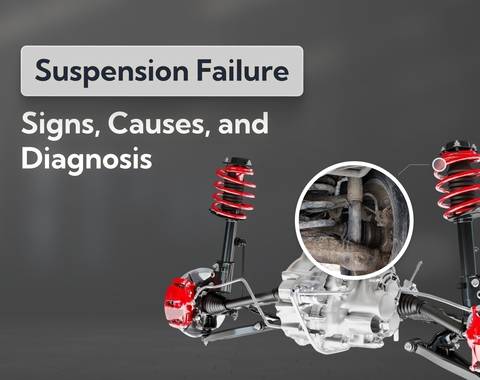
A car’s suspension system is the collection of springs, shock absorbers, control arms, bushings and linkages that work together to keep your tyres firmly on the road. It absorbs bumps, controls the car’s body movement, and stabilises it under braking, cornering and acceleration. That way, you have a safe and comfortable ride.
The main suspension components are:
- Springs: Support the car’s weight and absorb the initial impact from bumps.
- Shock absorbers (dampers): Control how fast springs move to keep the car from bouncing.
- Control arms: Guide the wheel’s up-and-down movement so handling stays predictable.
- Bushings: Provide flexible joints that reduce vibration and noise while keeping alignment tight.
- Anti-roll bars: Reduce body roll during cornering to keep the car flatter and more controlled.
- Ball joints: Allow the wheels to pivot smoothly for steering while handling vertical movement.
- Steering knuckle/hub assembly: Connects suspension to the wheel and ensures the tyre tracks correctly.
All of these parts work as a system. Springs absorb the bump, shocks slow the spring’s rebound, control arms and bushings keep the wheel moving in the correct path, anti-roll bars steady the body in corners and the knuckle maintains the tyre’s angle.
And all of this is done to make sure the wheels stay firmly in contact with the road for grip, stability and comfort.
What are the signs of suspension failure?
If your suspension is failing, the very first sign to pay attention for is a gradually bumpier ride. And once there’s damage to critical components, you’ll also notice the car leans, nose-dives when braking or has trouble steering. If the problem’s been going on for a while, it’ll also fail the ‘bounce test’ and you’ll notice uneven tyre wear.
Let’s take a closer look at what each of these suspension failure symptoms means:
- Bumpy or rough ride: A harsh, jittery ride usually means worn shocks or struts can’t control the springs anymore, so every bump travels straight into the cabin and the tyres struggle to stay planted. It’s especially noticeable on uneven surfaces (e.g. a speed bump) because that’s where damping control is needed most. If this is the case, your car won’t be able to properly cushion impacts, which makes the car difficult to control and uncomfortable to drive.
- Nose-diving when braking: If the front end dips aggressively when you hit the brakes, the front shocks have lost damping force, which transfers excessive weight to the front wheels and increases stopping distances by up to 20%. A lot of people think replacing shocks or arms is a simple swap, but modern cars rely on precise geometry (camber, caster, toe) to stay stable. If those angles aren’t reset after suspension work, you can end up with rapid tyre wear, wandering steering, and a car that never feels “right” even though the new parts are perfect. Like bumpiness, it’s one of the earlier signs of suspension wear, but you should still get it checked immediately because it makes your car less reliable in emergency braking and tight steering scenarios.
- Uneven tyre wear: Feathering, cupping or one-sided wear points to worn bushings, tired shocks or poor alignment, all of which wear down certain tyres unevenly or faster than others. Tyres don’t wear down after 1 or 2 drives, so this is one of those issues that points to an ongoing fault. On top of that, tyres that can’t grip properly are dangerous to drive because they negatively impact handling and braking efficiency. If you notice this, get the car looked at ASAP.
- Poor handling or steering response: Worn dampers, loose control arms and degraded bushings can all cause uncontrolled wheel movement, which shows up as drifting, swaying or delayed steering response as you drive. These issues will be even more pronounced during braking and cornering. Like tyre wear and nose-diving, loose or unsteady steering will increase your chances of losing control while driving.
- Vehicle pulling to one side: A pull during driving or braking comes from seized shocks, collapsed springs, worn bushings or alignment drift caused by suspension wear on one side. All of these things can alter wheel geometry, in turn leading to uneven steering forces. Aesthetics are the least of your worries, though, because that force affects handling safety and tyre wear. Getting a component inspection and professional alignment while it’s still early will save you from having to worry about those issues later.
- Excessive body roll in corners: If the car leans more than normal when you make turns, it’s either (a) that the anti-roll bar or its links are worn out or (b) the shocks can’t stabilise lateral movement anymore. When either of these things happen, they allow the car’s weight to shift too much, which you’ll feel as a reduction in tyre grip and steering response. If this happens, your chances of control during sharp turns are far greater, so you’ll need to take the car in for a suspension inspection and potential replacement.
- Clunking or knocking noises: If the car’s knocking too much when you drive over uneven surfaces, it normally means the control arm bushings, ball joints or drop links have come loose or worn out. When this happens, the metal components move out of tolerance, creating impact noise as the suspension moves. It’s particularly noticeable at lower speeds or during sharper turns. If the noises are consistent, the wear is going to create further mechanical damage in the very near future if you don’t have it looked at.
- Leaky or oily shock absorbers: Oil on the outside of the shock means the internal seal has failed. The damper has lost fluid and it’s lost its ability to effectively control wheel movement. Besides the visual aspect (leaks or oil coverage), you’ll notice the car bounces more on uneven roads and is generally less stable. If you’re seeing greasy streaks running down the shock body, the seal has already failed and you have to replace it immediately.
Since unsafe handling has safety implications for you and those you share the road with, it’s your responsibility as a driver to treat these warning signs with urgency. Keep up with your regular maintenance schedule as a preventative measure, and get problems looked at as soon as possible.
What are the causes of suspension failure?
Failure is usually the result of long-term wear, but will happen a lot sooner if it’s not properly maintained, or it’s suddenly damaged from a road impact. Each part of the system, from springs to joints, deteriorates under different driving conditions.
Suspension components fail due to worn shock absorbers, damaged springs, corroded mounts, overloading the car and continuously driving on rough roads. Environmental factors like potholes and salt corrosion will speed up this process.
A lot of this is solvable with proper maintenance (mainly parts replacements and alignment jobs) and good driving habits. But more on that later – let’s dive into what causes these issues so you can identify them early, before the damage gets worse and your repair bill shoots up.
- Hitting potholes or rough roads: Suddenly hitting a pothole, kerb or rough road surface while driving at regular speed could instantly damage suspension components. Those kinds of sharp impacts bend the suspension’s control arms, crack its springs and blow out shock seals, leaving the suspension unable to control wheel movement properly. It only takes one time to get unlucky here, so getting the car inspected afterwards is critical for your car’s safety, even if you think everything’s OK.
- Poor or irregular maintenance: Suspension systems need routine checks and cleaning to stay effective. So if you habitually skip alignment checks, ignore worn tyres and leave old bushings in place, you’re allowing dirt, rust and oil leaks to build up across the entire system. In the end, that’s what causes most suspensions to fail prematurely. On top of the fact that it keeps your suspension stable for a lot longer, regular servicing helps you detect early signs of damage, so you can address them before they become expensive full-system replacements.
- Overloaded vehicle weight: Carrying more weight than your suspension is designed for strains springs and dampers, causing it to sag and overheat inside the shocks. Over time, the over compression weakens the shocks, so they start to bounce excessively. In the near term, the ride is less stable and comfortable. And if you overload the car often enough, it’ll give out years before its projected useful life is up.
- Manufacturing defects or corrosion: Sometimes, material defects like weak welds and bad coatings allow moisture and salt to corrode suspension joints and mounts. The rust that results from this then weakens the springs, mounts and control arms until they crack or collapse. This is particularly common here in the UK because there are thousands of roads that get winter salt every year. And again, it’s something you can easily prevent with quality parts and routine inspections that’ll catch it before it’s widespread.
- Worn or damaged components: Everything in the suspension operates under constant stress, so natural wear eventually degrades the shocks, joints, bushings and mounts. Even if you’re not an off-roader and you live somewhere with well-paved roads, the constant motion, road vibration and exposure to environmental elements will eventually do the system in. This creates a domino effect – one failing part strains the next. If you inspect and replace damaged parts early, you’ll prevent that problem from snowballing into a total suspension failure.
What the experts say

Steven Jackson OBE

How to diagnose suspension problems?
To diagnose a suspension problem, you’ll run through a combination of visual and physical tests as well as a road test to understand where the problem stems from. You’ll start with a bounce test, which is the easiest, then move on to oil leaks and tyre wear. If all that checks out, take the car out and listen for strange noises while you drive it.
Though you’ll need a professional inspection for serious issues, these tests will tell you exactly how different parts of the system are (or aren’t) performing. It’s a critical first step because if you don’t know which part of the suspension system is failing, you can’t take the targeted action needed to replace it. You’ll end up wasting tons of money on unnecessary repairs.
- Bounce test and vehicle height check: The ‘bounce test’ quickly identifies worn shocks and struts or sagging springs. All you have to do is park on level ground, push firmly down on one corner of the car, release and watch the movement. A healthy suspension settles in 1 or 2 rebounds; if it goes for 3 or more, the damper is weak. Then, perform a height check by standing back and see if one corner sits noticeably lower. If it is, that's a clear sign of a tired spring and worn shocks. Once you do those two tests, you’ll have a foundational understanding of the car’s damping strength and overall suspension.
- Visual inspection of components: Inspect the visible suspension parts for leaks, corrosion, cracks, rust, loose joints and damaged bushings. Specifically, check the shock absorbers for oil residue, rubber bushes for cracks and metal parts for rust and loose bolts. This will confirm whether those components are generally healthy or are seriously damaged and need immediate replacement.
- Road test and handling observation: The road test reveals real-world symptoms you can’t see when the car’s parked. First, drive at low speed over small bumps to feel for knocks and excessive bounce. Then, test steering response with gentle lane changes. Brake firmly to see if the nose dives too much or the car pulls to one side. And on a safe road, take a moderate corner and check for excessive body roll. Handling issues normally point to a broader suspension system failure, so if any of these are noticeable, take it to a mechanic so they can test it with diagnostic equipment.
- Noise and vibration check: While driving, pay attention to vibrations through the steering wheel or seat (suspension and wheel alignment issues). At low speed, turn the wheel lock-to-lock and listen for knocking (worn ball joints or bushings). This aspect of the road test will tell you whether the joints, bushings and/or shock mounts are the issue. If the noise and vibrating are consistent, they require immediate inspection because that usually means one or more components is close to complete failure.
- Wheel and tyre inspection: Tyres sometimes show suspension issues earlier than the suspension itself, which is why it’s such a critical aspect of spotting underlying problems early. Start by inspecting the tyres for uneven wear patterns like cupping, feathering and inner-edge wear. Also check their pressure, tread depth and sidewalls. If you notice one or more of them wears faster than the others, it poses a tremendous safety risk during braking and cornering, so you need to take it to the garage for an alignment.
- Professional suspension diagnosis: A mechanic confirms the exact failing component using tools you probably don’t have, and can run advanced tests when multiple components show signs of wear. They use lifts, pry bars and diagnostic equipment to test joints, bushings, and dampers individually. They measure alignment, ride height, and damper performance (e.g. shock absorber force). Then, they’ll pinpoint which part is worn and give you a repair estimate. That way, you can fully restore the car before anything breaks or the car fails its next MOT.
How much does it cost to fix suspension failure?
Typical UK suspension repairs range from around £250 to £550 for shock absorbers, £250 to £500 for springs and £150 to £450 for control arms (though the final bill will depend on vehicle model, part condition and garage rates). The total cost varies based on which components are damaged, the type of vehicle and how extensive the particular issue is.
In any case, early repair prevents wider system wear and higher future costs. So it’s better to get a professional inspection now than to deal with a total system failure and serious safety issues later.
Average suspension repair costs (UK, 2026)
Suspension repairs run from as low as £40 for a simple drop link to £1,500+ for a full overhaul, depending on which components have failed and whether you’re replacing one side or both. Your car’s make and model, local garage rates and your suspension’s overall condition also play a role.
Repairs are a lot more common than replacement for suspension issues because the damage is usually localised rather than widespread. When suspension damage is limited, repair works because the costs stay manageable, the fix restores handling and safety immediately and you avoid the knock-on wear that would otherwise spread to the tyres, bushings and steering.
Full suspension replacement costs (UK, 2026)
For a full suspension overhaul including springs, shocks, bushes, arms and the whole lot, expect roughly £1,000 to £2,000 for most standard and mid-range cars and £2,000 to £5,000 for luxury brands like BMW and Mercedes.
Full suspension replacement is less common and more expensive, but sometimes necessary for older vehicles and severe damage that went unaddressed. The job requires professional fitting and alignment, so the cost increases dramatically with parts complexity (e.g. air or adaptive suspension systems).
Since it’s a more expensive repair, you’ll sometimes be given the choice between OEM and cheap aftermarket parts. It’s in your best interest to go with the former, even though it’s pricier. Full replacement restores long-term safety, handling and ride quality, but will only do so for the remaining life of your car if you invest in the parts specifically made for it.
Factors that affect suspension repair or replacement price
The main factors that affect suspension repair and replacement costs are vehicle make, part accessibility, alignments needed, an MOT retest (if you need one) and local garage labour rates.
- Vehicle make: Premium and complex models use multi-link setups and expensive suspension parts, which raises both parts and labour prices.
- Part accessibility: Tight engine bays, rusted bolts and subframe removal increase labour time and total repair cost.
- Alignment requirements: Most suspension jobs need 2- or 4-wheel alignment afterwards, which adds another £40 to £140 to the final bill.
- MOT retest: MOT failures might uncover multiple worn parts, and retest fees or extra fixes will increase the final bill.
- Labour rates: £50 to £80 per hour in the North; £100 to £140/hr around London and the South East.
- OEM vs aftermarket parts: OEM components cost more but match factory specs. Aftermarket parts lower upfront costs but vary in quality and long-term reliability.

Is it worth fixing suspension failure on your car?
Repair is worth it when only one or two components are worn, the car still holds decent value and the symptoms haven’t spread to multiple parts of the system. Fixing early will restore the car’s stabilising capabilities and prevent the kind of cascading wear that turns a £200 repair into a £1,000 overhaul.
When repair makes financial sense
Repair makes financial sense when:
- Only one or two components are worn (e.g. shock absorber, bushings)
- The car is relatively new and holds decent value
- Damage is caught early before it spreads
- Repair restores safe handling for a relatively low cost
Let’s say your 2018 Ford Focus with 50k miles develops a leaking rear shock and slight tyre cupping. Replacing the rear shock pair (£200 to £450) quickly restores stability. In this case, the car is still worth several thousand pounds and the issue is isolated.
As a general rule, the repair is <20 to 30% of the car’s value and there are no other major repairs looming, repair is a fantastic investment.
When full replacement is the better choice
- Full replacement is the smarter option when:
- Several components are worn at the same time (high-mileage cars)
- The car is in good overall condition and worth investing in
- Replacing shocks, springs, and bushings together improves long-term reliability
- Full replacement avoids repeated labour costs from fixing parts one by one
Say instead that your 2013 BMW 3 Series with 110k miles has weak front struts, cracked rear springs and bad front bushings. They’re individually replaceable, but labour overlaps heavily. Doing shocks, springs and bushings together (~£2,000) resets the entire system, improves the car’s handling and keeps you from paying multiple separate alignment charges.
If you’ll end up replacing 3 to 5 components within a year or two anyway, a full refresh will be cheaper long-term while still giving you the ROI benefit of restored safety and stability.
When to consider scrapping your car instead
It’s a better idea to scrap your car when:
- Repair costs exceed 50% of the car’s market value
- Severe corrosion or structural issues affect multiple suspension points
- Other major faults (engine, gearbox, frame) push the expenses further
- The car’s older than 10 years so the restoration has less long-term ROI
If your 2008 Vauxhall Astra worth £700 needs front shocks, springs, control arms and rear trailing arm bushes, that’s a £900 to £1,400 job before alignment. The repairs exceed vehicle value, and corrosion may make labour even worse. It’s better to cut your losses and scrap your car.
What are the preventive tips for car suspension maintenance?
Preventing premature damage to your suspension comes down to a few simple tips: regular inspections for leaks and cracks, keeping tyres balanced and properly inflated, wheel alignments and cleaning the underbody to remove salt and debris.
If you can do those five things, you’ve already fought half the battle. The rest is just replacing worn parts before they break, because that’s what prevents wider mechanical failure.
When you maintain the car properly and consistently, the car will handle better and ride smoother, and you’ll have no problems passing your MOT.
Inspect the Suspension Periodically: Every couple of weeks, carry out visual and physical suspension inspections helps detect early signs of wear. And have the suspension checked during routine servicing or at least once or twice a year. That way, you can catch worn shocks, cracked springs, loose bushings and leaking mounts before they affect handling or cause an MOT failure.
- Align the Wheels and Maintain Tire Health: To reduce stress on the suspension system, keep your tyres properly inflated and rotate them as recommended in your owner’s manual. Check your alignment every 6 to 12 months, and after any hard impact (like hitting a large pothole). This’ll not only protect your suspension, but it’ll also help your tyres last longer.
- Protect Against Rust and Clean the Underbody: When the underbody is clean, it protects the suspension parts from road salt, moisture and debris buildup that lead to rust and corrosion. Rinse the underbody in winter and after driving on salted roads to stop those issues from attacking the system’s springs, control arms and mounting points. And use a rust-preventive coating to prevent it from happening as often. If you do this every 2 to 4 months (for normal driving), you’ll significantly extend the lifespan of your suspension.
- Replace worn components promptly: Fixing a rattly drop link, leaking shock, or split bushing early prevents cascading damage to tyres, joints and alignment. This keeps repair costs small instead of letting them become a full suspension overhaul. Not to mention, it’ll maintain your car’s balance, handling and overall performance a whole lot better.
- Avoid overloading the vehicle: Carrying more weight than the manufacturer’s limit puts unnecessary strain on the suspension system. It compresses the springs and shocks, which in turn reduces clearance and wears down your internals. Sticking within the car’s load rating protects springs and dampers from excess strain, prevents sagging and stops the shocks from overheating or bottoming out under heavy loads.
Frequently asked questions
You can physically drive with damaged suspension, but the car becomes less stable, takes longer to stop and might lose tyre contact when you go over bumps. Doing so also speeds up wear on your tyres, bushings and steering components, turning a small repair into a costly one.
Most suspension components last 50,000 to 100,000 miles depending on your driving style, road quality and vehicle type. Harsh roads, heavy loads and aggressive driving will all shorten that lifespan significantly.
Suspension issues absolutely can cause an MOT failure because worn shocks, cracked springs, loose joints, or excessive play are all treated as safety-critical defects. Even minor leaks or worn bushings can trigger advisories that should be addressed quickly.
You can replace suspension parts individually, but shocks, springs and ball joints are almost always replaced in pairs to keep the car balanced and predictable. Mixing new and worn parts leads to uneven handling and faster wear on the remaining components. Replacing them together keeps you from having to come back to replace the other one shortly after.
Ignoring suspension issues causes the car to handle poorly, brake over longer distances and wear down the tyres unevenly. If you ignore it for several weeks, it’ll start to stress on the steering and chassis components as well. Small problems quickly snowball into multiple expensive repairs and will eventually make the car totally unsafe to drive.
A completely failed suspension shows severe symptoms like uncontrollable bouncing, sagging ride height, loud knocking and wheels that lose contact with the ground when going over bumps. Worn suspension involves milder issues like vague steering and uneven tyre wear. A visual check for leaks, cracks and broken components confirms the severity.
Insurance generally does not cover suspension failure because wear and tear isn’t included in standard policies, though accident-related damage is usually covered if it resulted from a collision. It’s always worth checking the policy wording because maintenance-related faults are almost always excluded.
About Car.co.uk

Share on
Latest news & blogs