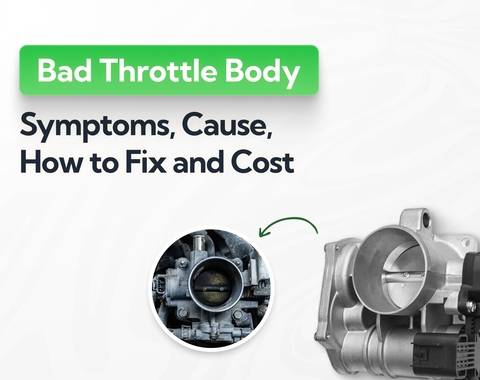
Bad Throttle Body: Symptoms, Causes, How to Fix and Costs
A bad throttle body is dangerous to drive with because it makes acceleration unpredictable. Knowing the signs to look for and how to prepare will prevent you from turning a simple £400 replacement into a four-figure engine repair bill.
Last updated: 7th January, 2026

Anthony Sharkey is COO at New Reg Limited (Car.co.uk, Trader.co.uk, Garage.co.uk), driving innovation in vehicle recycling, logistics, and customer experience.
Listen to this story
The throttle body plays a quiet but critical role in how your engine behaves. It controls how much air enters the engine, responding directly to how hard you press the accelerator. More air means more power. Less air means the engine calms down. When it’s working properly, you never think about it. And when it isn’t… you definitely do.
A failing throttle body causes erratic acceleration and stalling, and might even result in a complete loss of power at the worst possible moment (like pulling out of a junction or joining a motorway). Ignore it for too long and what starts as a drivability issue will become a tremendous safety risk and an expensive repair that didn’t need to happen.
In this guide, you’ll learn what a bad throttle body actually is, the common symptoms drivers notice first, what causes throttle bodies to fail, how the problem is usually fixed and what it’ll cost to do so.
What's in this article
- 3. How to fix a bad throttle body: repair or replace?
- 4. How much does throttle body repair or replacement cost?
- 5. Is it worth repairing a bad throttle body?
- 6. Can a bad throttle body cause an engine misfire?
- 7. Can a bad throttle body cause black smoke?
- 8. What is the lifespan of a throttle body?
- 9. Can a bad battery cause throttle body symptoms?
- 10. When should you consider scrapping your car instead of repairing?
- 11. How can you prevent throttle body problems?
What are the signs and symptoms of a bad throttle body?
Catching throttle body problems early makes a real difference. The first signs are subtle; you’ll notice a sluggish response, odd behaviour when idling and hesitation, which you might brush off as “one of those things”. But if you don’t have them looked at, those small changes can quickly escalate into unsafe power loss and catastrophic damage to other engine components.
Below are the most common warning signs drivers experience when a throttle body starts to fail, and what each symptom usually means in real-world driving.
Immediate warning signs
The following are the symptoms that usually show up first. They’re hard to ignore once you know what you’re feeling, and they tend to get worse rather than better.
- Check engine light comes on: A faulty throttle body triggers fault codes related to throttle position or airflow. Common ones include P0120 through P0124 (throttle position sensor range or performance) and P2100 through P2119 (electronic throttle control faults). The engine management light may come and go at first, which tricks people into ignoring it.
- Poor or rough idle, or sudden stalling: The engine struggles to maintain a steady idle because airflow isn’t being regulated properly. You may notice the revs hunting up and down, or the engine cutting out entirely when coming to a stop.
- Delayed throttle response or hesitation: You press the accelerator and nothing happens for a moment. Then the car lurches forward. This lag is a classic sign the throttle plate isn’t opening or closing as it should.
- Engine surging or revving unexpectedly: The engine revs rise or fall without any change in pedal input. It can feel unsettling, especially in traffic, and it’s a strong indicator the throttle body is sending inconsistent signals to the engine control unit.
Performance-related symptoms
Once a throttle body problem moves past the early warning stage, you’ll start to feel it in how the car drives day to day. The engine still runs, but not the way it should. If you notice any of the following, it means the problem has gotten more serious.
- Reduced fuel efficiency: When airflow isn’t being measured or controlled correctly, the engine struggles to balance the air–fuel mixture. That inefficiency shows up at the pump, even if your driving habits haven’t changed.
- Loss of power or sluggish acceleration: The car feels flat and unresponsive, especially when pulling away or overtaking. Pressing the accelerator harder doesn’t always help, which is frustrating (and potentially risky).
- Difficulty starting the engine: A failing throttle body can restrict airflow during start-up, causing longer cranking times or multiple attempts before the engine fires properly.
- Inconsistent or jerky acceleration: Power delivery becomes uneven. The car may surge, hesitate, then surge again, making smooth and predictable driving almost impossible. This is often mistaken for gearbox failure, but the root cause can sometimes also be the throttle body.
Physical and mechanical indicators
Since it’s an internal component of your car’s intake system, the part itself isn’t visible without opening the hood. But when you do, there are a few signs you can see pretty clearly. A quick inspection for the following can sometimes confirm what the other symptoms are already telling you.
- Dirty or sticky throttle plate: When you look inside the throttle body, the plate should move freely and sit cleanly in its housing. If it feels sticky or doesn’t return smoothly, airflow control will be inconsistent.
- Carbon buildup around the throttle opening: Over time, oil vapour and exhaust gases leave behind carbon deposits. These build up around the edges of the throttle body and restrict airflow, particularly at idle and low speeds.
- Electrical connection or wiring issues: Modern throttle bodies rely on sensors and electronic actuators. Corroded connectors, damaged wiring, or loose plugs can interrupt signals between the throttle body and the engine control unit, triggering erratic behaviour or fault codes.
What causes throttle body failure?
To understand why throttle bodies fail, it helps to know what they’re doing all the time you’re driving.
The throttle body is essentially an air control valve. When you press the gas pedal, it opens a plate inside the throttle body to allow more air into the engine. The engine control unit then adds the correct amount of fuel to match that airflow. Modern cars do this electronically using sensors and a motor rather than a physical cable.
Problems start when that airflow control becomes inaccurate or unreliable. Then, dirt builds up, components wear out, sensors misread inputs or the electrical signals break down. The throttle body may open too much, not enough, or not when it’s supposed to. That mismatch is what causes hesitation, surging, stalling and activates the warning light.
Below are the most common reasons throttle bodies fail, and how each one disrupts normal engine operation.
Carbon buildup and contamination
Carbon buildup is the most common cause of throttle body trouble, and it’s largely unavoidable. As the engine runs, oil vapours from the crankcase ventilation system and combustion byproducts pass through the intake. Over time, they stick to the inside of the throttle body and coat the throttle plate.
As carbon accumulates, the throttle plate can no longer open and close smoothly. Airflow becomes restricted at idle and low speeds, which is why rough idling and stalling are often the earliest symptoms. The engine is essentially being starved of air when it needs precise control the most.
Cars that do lots of short trips, sit unused for long periods, or miss routine servicing tend to build up contamination faster. Driving in dusty or polluted environments also adds to it because that means more particles make their way into the intake system.
Electrical and sensor failures
The throttle position sensor (TPS) tells the engine control unit exactly how far the throttle plate is open. When it begins to fail, the readings are inaccurate or inconsistent, so the ECU responds with the wrong fuel delivery.
Wiring issues are another common culprit. Heat, vibration and moisture damage the wiring harness over time. Corrosion in connectors or broken internal wires can interrupt signals, even if everything looks fine from the outside. This is why throttle-related faults sometimes appear and disappear unpredictably.
Then there’s the electronic throttle control system itself. Because there’s no physical cable linking the pedal to the throttle body, any fault in the control module, actuator motor or software logic might throw the whole system out of balance. When that happens, the car will limit power intentionally to protect itself (this is called limp mode).
Mechanical wear and damage
The throttle plate can begin to bind or stick as pivot points wear or deposits harden unevenly. When it no longer moves freely, airflow becomes inconsistent even if the ECU gets the right readings. You get the same results: hesitation, unstable idling and sudden changes in engine speed.
The return spring mechanism is another weak point over time. Its job is to bring the throttle plate back to its resting position when you lift off the accelerator. If the spring weakens or fails, the throttle may react slowly or stay slightly open, leading to high revs or unpredictable response.
There’s also the risk of physical damage. Minor collisions and improper installation during previous repairs (especially in the engine bay) could distort the throttle body housing or misalign components.
Environmental and usage factors
Extreme temperatures put extra stress on electronic components. Very hot conditions degrade sensors and wiring insulation; cold weather stiffens the moving parts and exposes weak electrical connections.
Poor air filter maintenance speeds everything up. A clogged or damaged air filter lets dust and debris into the intake system. Those abrasive particles settle inside the throttle body and gradually wear down the internal components.
High-mileage wear and tear is also a factor. Throttle bodies are constantly adjusting the airflow every time you touch the accelerator. On cars with more than 150,000 miles, the internals simply reach the end of their service life – even if you’ve maintained them well.
How to fix a bad throttle body: repair or replace?
The right solution to a bad throttle body depends on whether the issue is caused by dirt and contamination, or by an electronic or mechanical failure. If the throttle body is dirty but still functioning correctly, cleaning may be all it needs. If sensors, motors or internal components have failed, replacement is usually the only reliable option.
Now, let’s look at how each approach works and when it makes sense to use one or the other.
Cleaning the throttle body (repair option)
Cleaning is the right fix when the problem is dirt rather than damage. If carbon buildup is light, there’s no mechanical damage and no throttle-related fault codes pointing to sensors or electronics, a clean normally restores normal operation. This is especially true when symptoms are mild and have only appeared recently.
You can clean the throttle body yourself by following these steps:
- Let the engine cool completely: Work only on a cold engine, or else you could burn yourself and cause the cleaner to evaporate too quickly.
- Disconnect the battery: This reduces the risk of triggering fault codes and damaging electronic throttle components.
Remove the intake hose to access the throttle body: Use basic hand tools and take note of how everything is positioned for reassembly. - Put on gloves and ventilate the area: Throttle body cleaner is harsh on skin and fumes build up quickly in enclosed spaces.
- Spray throttle body cleaner onto the plate and housing: Use a cleaner specifically designed for throttle bodies, never a carb cleaner or brake cleaner.
- Gently remove carbon with a soft brush or lint-free cloth: Do not force the throttle plate or scrape deposits with hard tools.
- Allow the throttle body to dry fully: Residual cleaner can affect idle control if the engine is started too soon.
- Reassemble and reconnect everything carefully: Make sure all the hoses and clamps are secure to prevent vacuum leaks.
- Carry out a throttle relearn if required: Some vehicles need recalibration so the engine control unit relearns correct idle airflow.
Keep in mind, though, that a professional cleaning is better than DIY when the throttle body is difficult to access. A garage can remove it if they have to, clean it thoroughly, check all the sensors and wiring, clear fault codes and perform the proper relearn procedure. It costs more than DIY because of the labour, but it eliminates the risk of accidental damage.
Replacing the throttle body
If the throttle plate or housing is physically damaged, internal sensors like the throttle position sensor have failed or symptoms persist after a proper clean, the throttle body itself is no longer reliable. At that point, it’s dangerous to keep driving the car because it’ll only become more unpredictable over time.
When choosing a replacement, there are OEM and aftermarket options. OEM throttle bodies match the original spec, so they offer consistency, optimal fitment and long-term reliability. Aftermarket units are cheaper but quality varies a lot. And they might void your warranty or come without one of their own.
Installation is where things get more complicated. DIY replacement is possible for experienced home mechanics, most vehicles require a throttle body relearn or reprogramming after installation so the ECU can recalibrate airflow and idle control. That’s something only a professional can handle.
At a mechanic’s garage, replacement and recalibration usually take one to two hours, and the job is completed with diagnostic confirmation that the system is functioning correctly.
What the experts say

Steven Jackson OBE

How much does throttle body repair or replacement cost?
Repairing a throttle body by cleaning it will generally cost £150 or less, but a full replacement can run you £500 or more. The final price depends on your car’s make and model, whether the issue can be fixed with cleaning or needs full replacement and – crucially – local labour rates.
Where you take the car also matters. Main dealers charge more per hour than independent garages, sometimes as much as double.
Here’s a breakdown of what drivers pay here in the UK, broken down by repair type.
Throttle body cleaning costs
Cleaning is the cheapest option when it’s viable. It applies when the throttle body is dirty but not damaged.
- Professional cleaning: Typically ranges between £80 and £150
- Diagnostic checks: £40 to £120 before any work starts
- DIY cleaning (parts only): Ranges between £20 and £30
Labour time is usually short, but ease of access will push the price up or down. Some garages will also charge separately for diagnostics before cleaning.
Throttle body repair costs
There’s no strict “repair” labour price separate from cleaning or full replacement in most shops, but minor fixes like electrical connector cleaning or gasket replacement can bump the bill. It’s usually combined with cleaning and included in that labour cost rather than itemised separately.
You can expect these additional costs to increase the final bill by somewhere between £100 and £300, but the costs vary depending on fault-finding time. Repairs of this type rarely come with long warranties, which is why most garages will just recommend replacement if the faults are internal.
Throttle body replacement costs
Replacement is the most expensive route, but also the most definitive fix. Across common UK models, full throttle body replacement (parts + labour) sits in the ballpark of:
- £250 to £420 for everyday cars like a Ford Fiesta, VW Polo, Vauxhall Corsa, BMW 3-Series or Audi A4 at independent garages
- £500 to £700+ at dealerships and for larger SUVs or premium cars.
Keep in mind, too, that if your car is under manufacturer warranty or an extended warranty plan, throttle body replacement may be partially or fully covered. This is especially possible if the failure is electronic rather than contamination-related. Because of that, always verify the coverage before authorising work at the garage.
And of course, if you’re unsure which ‘fix’ category your issue falls into, a proper diagnostic scan first is money well spent. If you skip it and do the wrong repair, you’re paying twice, or overspending on a full replacement you didn’t need.
Is it worth repairing a bad throttle body?
Whether it’s worth repairing a bad throttle body depends on cost, vehicle age and how well the car runs overall.
If the problem is minor, repairing makes sense. A dirty throttle body can often be cleaned, restoring smooth airflow, improving fuel efficiency and keeping emissions in check. It’s cheaper and works well when symptoms are recent.
Replacement is about reliability. When it’s the sensors, actuators or internal components that are failing, cleaning won’t do anything meaningful. A new throttle body costs more but protects engine health and prevents repeat issues.
Repair or clean if:
- Carbon contamination is the main issue.
- Sensor readings are mostly stable.
Replace if:
- The actuator or internal sensors have failed.
- There’s severe wear or physical damage.
Can a bad throttle body cause an engine misfire?
A bad throttle body can indirectly cause an engine misfire. A failing throttle body doesn’t create a spark problem, but it can set the conditions that cause misfires.
The throttle body controls incoming air. When airflow is inconsistent because the plate sticks, sensors misread position or the actuator lags, the ECU can’t maintain the correct air-fuel mixture. Cylinders run too lean or too rich, and combustion becomes unstable. That instability shows up as an engine misfire.
It’s important to separate throttle-related misfires from ignition-related misfires. Ignition issues are caused by spark plugs, coils and leads failing to ignite the mixture. Throttle body issues cause misfires by feeding the wrong mixture into cylinders that otherwise have healthy ignition components.
How it’s confirmed diagnostically:
- Scan for airflow- and throttle-related fault codes
- Check live throttle position and airflow data
- Rule out spark plug and coil faults first
Misfires linked to airflow problems appear as P0300-P0308 codes (random or cylinder-specific misfires). On their own, these codes don’t confirm a bad throttle body; but combined with throttle faults or airflow irregularities, they point in that direction.
Can a bad throttle body cause black smoke?
A bad throttle body can lead to black smoke when it upsets the air-fuel balance. When the throttle body doesn’t allow enough air into the engine, the ECU sometimes overcompensates by adding extra fuel. That rich mixture doesn’t burn cleanly, and the excess fuel exits the exhaust as black smoke.
This is different from other smoke types.
- Black smoke points to excess fuel.
- White smoke is usually coolant or condensation.
- Blue smoke indicates oil burning.
You should consider the throttle body as a suspect if black smoke appears alongside poor throttle response, rough idle and throttle-related fault codes. And regardless, it’s something you should investigate ASAP because a rich fuel mixture is terrible for your fuel economy and will eventually damage your engine.

What is the lifespan of a throttle body?
Most throttle bodies last 100,000 to 150,000 miles or more. Many outlive that range if the car is well maintained and driven in favourable conditions.
A few factors make a big difference to longevity:
- Maintenance habits: Regular servicing and air filter changes slow contamination.
- Driving conditions: Short trips, heavy traffic, aggressive driving, dust and pollution wear it out faster.
- Vehicle quality and brand: Higher-quality cars and their components will last longer on average.
As a throttle body nears the end of its life, you’ll the car is rough or unstable when it idles. The throttle response will also be delayed and you’ll get a warning light on your dash. You might clean the throttle body to remedy the issue, but it’ll come back shortly thereafter.
As for prevention, there are a few pro tips to extent the throttle body’s lifespan:
- Replace air filters on schedule – you’ll find this in your owner’s manual.
- Address small drivability changes as soon as they come up.
- Consider periodic throttle body cleaning before heavy buildup forms.
These simple steps won’t make it last forever, but they will certainly delay (if not prevent) expensive repairs
Can a bad battery cause throttle body symptoms?
Modern electronic throttle bodies are highly voltage-sensitive, so a weak battery can absolutely mimic throttle body failure. This is why the overall health of your car’s entire electrical system is so important.
The throttle control module relies on stable voltage to interpret pedal input and position the throttle plate accurately. When battery voltage drops (e.g. during starting or idling), the signals aren’t reliable. The ECU will limit throttle response and trigger warning lights when this happens. It might even put the car into limp mode.
Battery-related throttle symptoms often look like:
- Intermittent hesitation or poor response.
- Throttle warnings that appear after starting.
- Issues that improve after the car has been running for a while.
The proper diagnostic approach here is simple: test the battery first. True throttle body failure tends to be more consistent and doesn’t disappear once voltage stabilises.
You should also know that after battery replacement or disconnection, most vehicles will require a throttle body relearn. This is because when you disconnect the battery, the ECU loses the settings it learned for the electronic throttle.
When should you consider scrapping your car instead of repairing?
And if the cost of fixing the problem exceeds 50% of the car’s current market value, it’s always a better idea to scrap it. This is common when your car’s already more than 10 years old and within (or past) the 100,000 to 150,000-mile range.
It’s also better to scrap your car when:
- Throttle body issues keep returning despite cleaning or replacement.
- The vehicle is aging and showing multiple additional faults.
- Expensive control modules or sensors are failing alongside it.
- Repairs are cheap but you know near-future maintenance will push it over that 50% threshold.
That being said, there are still upsides when scrapping. Doing it responsibly allows parts to be recycled or reused, and you’ll receive a payout on the spot based on the car’s weight and condition. In some cases, parting the car out can return more than repairing it ever would have.
Now… if your car is otherwise in good shape, proper maintenance will prevent you from having to make these decisions altogether.
How can you prevent throttle body problems?
Preventive maintenance goes a long way, and it’s easy to do. A little attention keeps the throttle body working properly and helps protect the engine as a whole.
Use these 5 tips to prevent throttle body problems:
- Clean the throttle body periodically: Light carbon buildup is normal. Cleaning it before deposits harden prevents sticking and airflow restriction.
- Replace the air filter regularly: A clean filter stops dust and debris entering the intake, slowing contamination inside the throttle body.
- Avoid over-oiling performance air filters: Excess oil can coat sensors and the throttle plate, causing inaccurate airflow readings.
- Use good-quality fuel: Better fuel burns cleaner and reduces the amount of residue passing through the intake system.
- Avoid constant short trips: Engines that rarely reach full operating temperature build deposits faster. Occasional longer drives burn off some of that moisture and residue.
These small habits won’t eliminate wear completely, but they will delay throttle body problems by several years.
Frequently asked questions
A throttle body cleaning usually takes 30 to 60 minutes. How easy the throttle body is to access and whether it needs a relearn procedure are the two factors that determine whether it’s on the lower or higher end of that spectrum.
You technically can drive with a bad throttle body for a very short amount of time, but it’s strongly advised against due to the significant safety risks. The car could suddenly stall or fail to accelerate, which makes driving dangerous for you and others on the road.
Not to mention, improper air-fuel mixtures can completely wreck your catalytic converter and cause catastrophic engine damage. If that happens, you’ll be looking at a multi-four-figure repair bill instead of a few hundred quid.
A bad throttle body will throw an error code, but it won’t always do so right away. A failing throttle body commonly triggers fault codes linked to throttle position (P0120-P0124), airflow (P2100-P2119) or actuator control (P2176).
In early stages, symptoms like hesitation or rough idle can appear without any warning light. As the fault worsens or becomes consistent, the engine control unit is more likely to log a code and illuminate the engine management light.
The throttle body can be covered under warranty, yes. Manufacturer and extended warranties sometimes cover electronic or mechanical failure, but contamination-related issues are normally excluded because they don’t point to a fault the manufacturer caused.
Mechanical throttle bodies use a physical cable from the accelerator to open and close the throttle plate directly, so engine airflow responds purely to pedal movement, with minimal electronic intervention. Electronic throttle bodies use sensors and a motor, which offers better control but also greater sensitivity to electrical issues.
About Car.co.uk

Share on
Latest news & blogs